



REUTERS/Phil Noble
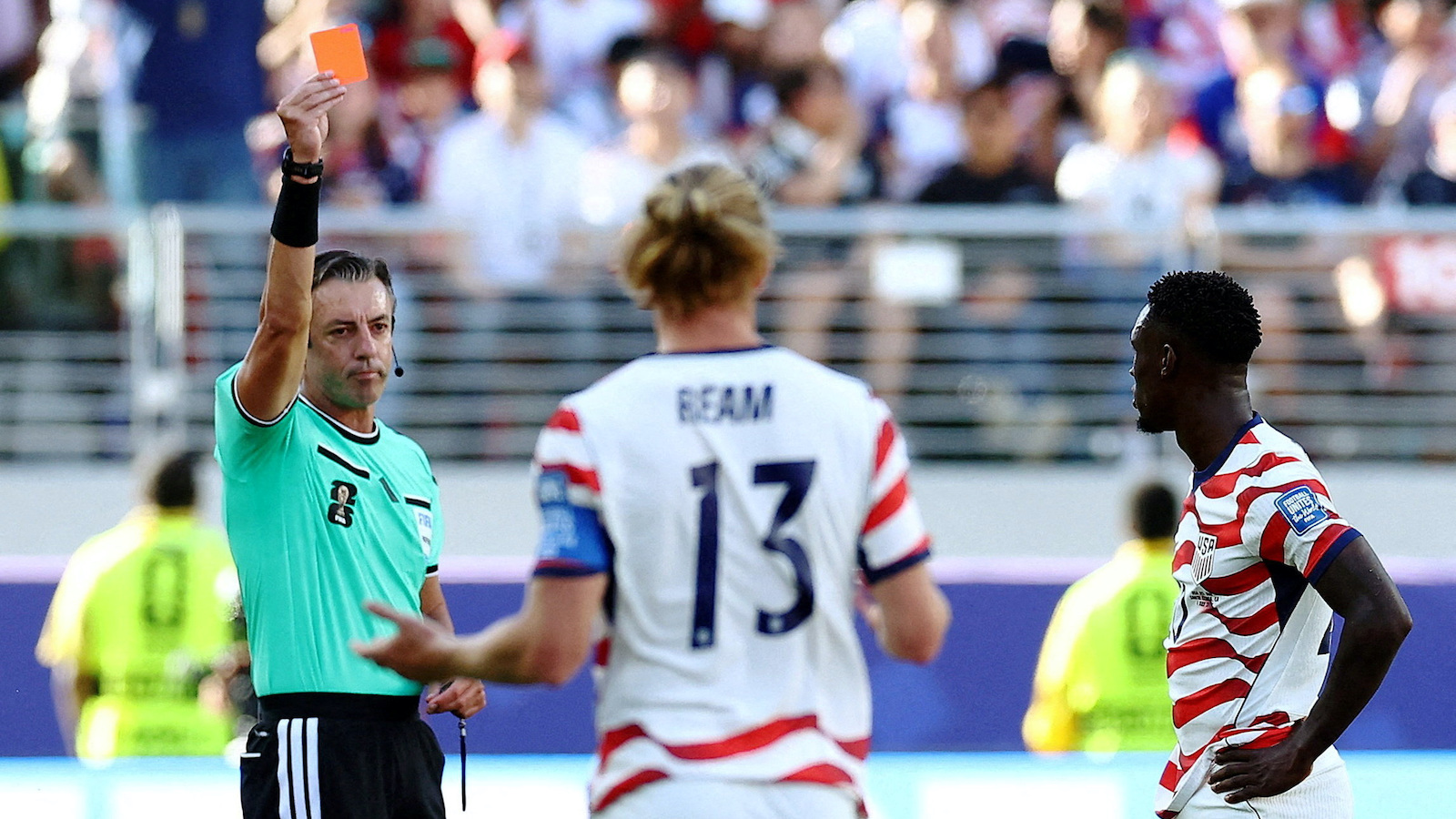
Folarin Balogun is eligible to play against Belgium in the Round of 16
FIFA shocked the soccer world on Sunday by announcing that USMNT striker Folarin Balogun would be eligible to play against Belgium in the Round of 16 on Monday night despite his red card in the previous round against Bosnia and Herzegovina. Europeans haven’t taken the news well.
In the aftermath of the decision to suspend star USMNT forward Folarin Balgoun’s one-game ban, thus making available to play against Belgium in the United States Round of 16 match up on Monday night — Belgium’s football federation released a statement saying they were astonished at the decision and were exploring their recourse options.
UEFA releases statement calling FIFA’s decision to suspend Folarin Balogun’s one-game ban “unprecedented, incomprehensible and unjustifiable”
That statement from Belgium was followed up by another from UEFA, which is essentially the FIFA of Europe, as it is the governing body of soccer on the continent — what FIFA is to the World Cup, UEFA is to the Champions League and the Euros.
UEFA’s statement was as similarly aghast as Belgium’s, saying that the “unprecedented, incomprehensible and unjustifiable” decision “crossed a red line.”
“Yesterday’s decision to suspend for a probationary period of a year the implementation of the one-match automatic suspension following the red card issued to the player Folarin Balogun crossed a red line,” the statement reads.
“Football, like any other sports, relies on rules, which are the basis for fair, honest and transparent competition. Sometimes rules are open to interpretation. In this case not. A minimum automatic suspension of one match following a red card is not a discretionary option and does not require the decision of a competent body to be enacted. It is a principle embedded in regulations, which cannot be made subject to exceptions, let alone in the middle of a tournament where several other players have been in the same situation and regularly served their suspension,” UEFA continued.
“When the certainty of rules is no longer guaranteed by its guardians, the integrity of the game is at stake and the credibility of a competition is undermined. Equally, such decision creates a precedent in the ongoing tournament, where similar situations will now require an equal treatment, to the detriment of the competition. Football is the most loved sport in the world because it is a beautiful game and is trusted because it is played everywhere with the same laws. A tournament is never a pure standalone and, if the tournament in question is the World Cup, it has the power to drive positive or negative consequences on the game as a whole.”
In their official statement explaining the decision, FIFA cited “article 27 of the FIFA disciplinary code, ” which gives the organization the power to “suspend the enforcement of a previously imposed disciplinary sanction.”
Belgium, however, countered that “Article 66.4 of the same FIFA Disciplinary Code clearly provides that a red card [sending-off] automatically results in a suspension for the team’s next match, as has been the case for all previous red cards issued during this FIFA World Cup.”
The sporting morality and legality of the Balogun decision will remain up hotly debated for as long as the United States remain in the 2026 World Cup, and deservedly so. But what’s undeniable is that UEFA making a stink about a suspect decision or ruling is the pot calling the kettle black.
Former UEFA president Michel Platini was charged with fraud in 2021 after FIFA — under then-president Sepp Blatter — made a secret 2 million Swiss franc payment to Platini in February 2011, which prosecutors alleged damaged FIFA’s assets and unlawfully enriched Platini.
Then there’s the Manchester City saga. In 2020, UEFA handed Man City a two-year ban from European competition and a €30 million fine for breaching Financial Fair Play rules, which much of the sports world had seen as long-deserved justice for City’s financial expenditure.
Five months later, however, the Court of Arbitration for Sport overturned the ban entirely and reduced the fine, ruling that the core allegation — that City had disguised owner equity as sponsorship contributions — was either unproven or time-barred under UEFA’s own statute of limitations. Essentially, UEFA filed a charge but then couldn’t — or didn’t try to — prove it.
And those are just the most high-profile legal incidents. Ask any European soccer fan what they think about the officiating. Or the favoritism toward big clubs in the Champions League and traditional powerhouse nations in the Euros. When it comes to UEFA lecturing FIFA, the only appropriate response is essentially this LeBron meme:
lebron, alperen sengun | no not you, you dont say that, you the only person out here that ain’t allowed to say that pic.twitter.com/OmrQKrWveg
— r e a c t i o n s (@Reactions_vids) May 5, 2026