



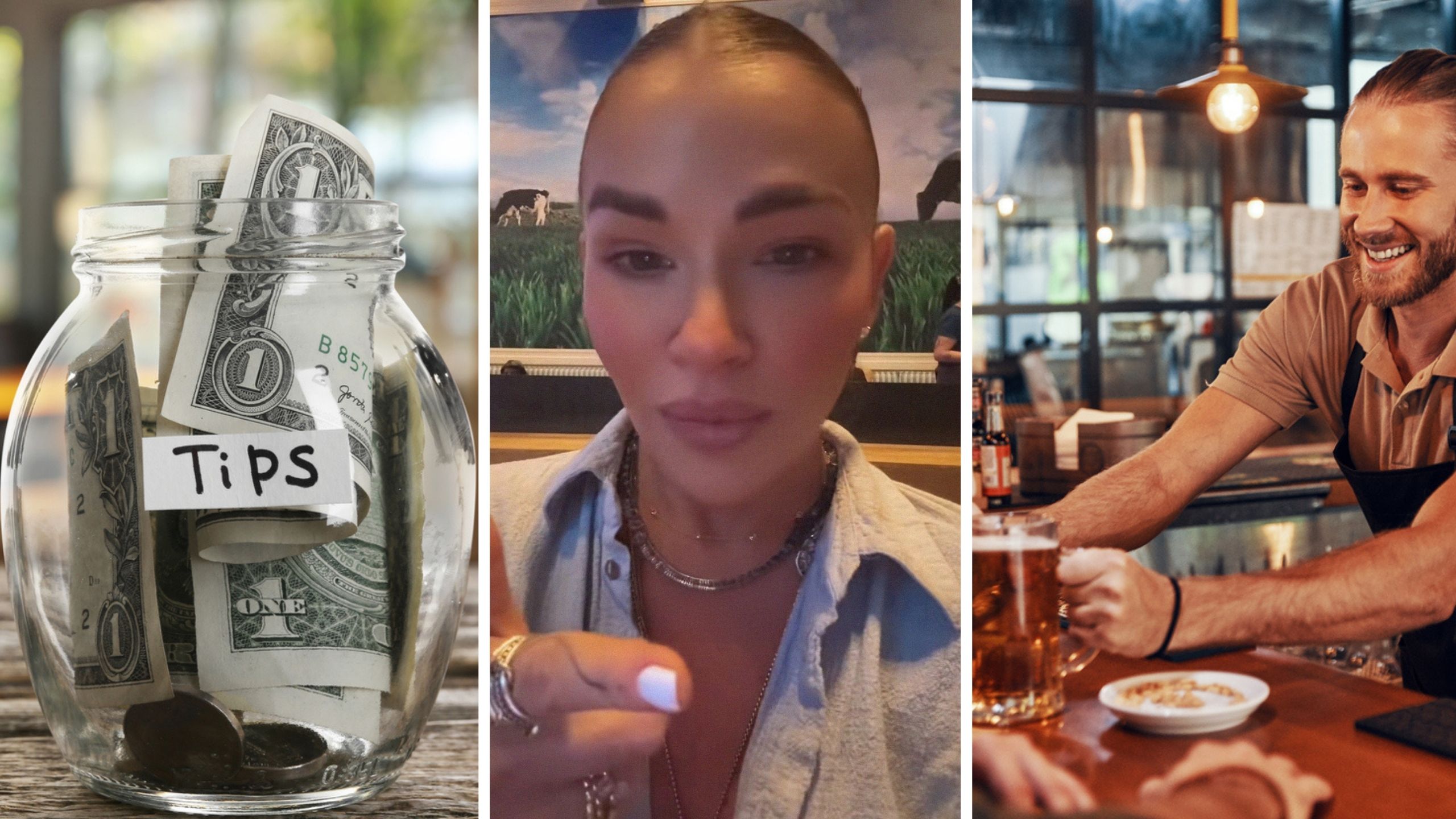
An Arizona woman, who says she’s a psychologist, shared a tip for servers and bartenders to make more money during their shifts. The secret? Say the higher number first when making an upsell.
Samantha Harper (@sam_e_peace), whose video has received more than 105,000 views, said her method “ will get you a little extra tips.”
She says she took herself on a date to a restaurant in Scottsdale.
“The bartender asked me if I wanted a 6-ounce or a 9-ounce glass of wine, and I said 6,” Harper says. “And then he asked the gentleman next to me, ‘Do you want a 16-ounce or a 20-ounce glass of beer?'”
Harper says she asked the bartender if they’d be willing to do a little psychology experiment. She says she encouraged him to say the higher number first and then say the lower one.
Harper says she told the bartender, “So if you were to ask me, ‘Do you want 9 or 6?’ with a little bit of a pause in between and an inflection higher on the 9—higher on the bigger number—’Do you want a 20-ounce glass or 16-ounce? That alone will get you the higher number, which will give you more tips.”
Harper told BroBible via voice memo that viewers misunderstood the intention of her video.
“Some people got it a little twisted online and were commenting about pushing alcohol, and … they’re missing the point,” Harper said. “It wasn’t about pushing alcohol as a sales tactic and psychology more so than, like, the actual item. So some of these psychology hacks can be used in lots of different scenarios.”
Harper said she worked in sales before studying psychology. She reached out to the bartender after he mentioned working at the restaurant for “11 years,” and she said he was “really receptive” to the hack.
“I would use these tactics, and I would be the top salesperson in the industries that I worked in. So I know that they work, and I was just trying to help some people out in the industry just to make a little bit more money,” she added.
The Psychology
The little trick can increase the overall cost of the tab, which, in turn, increases the suggested tip. But how does it work psychologically?
Harper’s strategy takes advantage of the anchoring bias. Anchoring bias is a cognitive bias that “involves relying heavily on the first piece of information (the ‘anchor’) encountered when making decisions or estimates,” according to SimplyPsychology. This strategy may also relate to the primacy effect, in which people tend to remember the first items on a list better than later ones, which can have an impact on their decision-making.
Other Tricks
In the comments section, hospitality workers and customers shared the tricks they have seen in the industry. Some differ from Harper’s. For instance, a number of commenters recommended removing the choice altogether. If a bartender only tells their customers about harder-to-commit options on the table, it’s easier to get a yes.
“Nah, babe. ‘You’re doin the 9 oz?’ Is all you need for the upsell. Give em a yes yes situation. They don’t need the 6 oz option,” one viewer wrote.
Other commenters recommended taking advantage of assumption. For instance, one commenter shared a trick that a bartender used on their group while dining at an airport. “The bartender would ask every single person when they ordered a mixed drink, ‘oh, you probably want a double then, right? Every single person said, sure, why not? Lol,” they wrote.
Then, there were commenters who mentioned the Sullivan nod, a simple gesture that could subconsciously suggest a purchase or addition to the bill.
@sam_e_peace Psychology hack for anyone in the service indusrty to get higher tips!! #psychology #artofpersuasion #psychologyhack #serviceindustry