



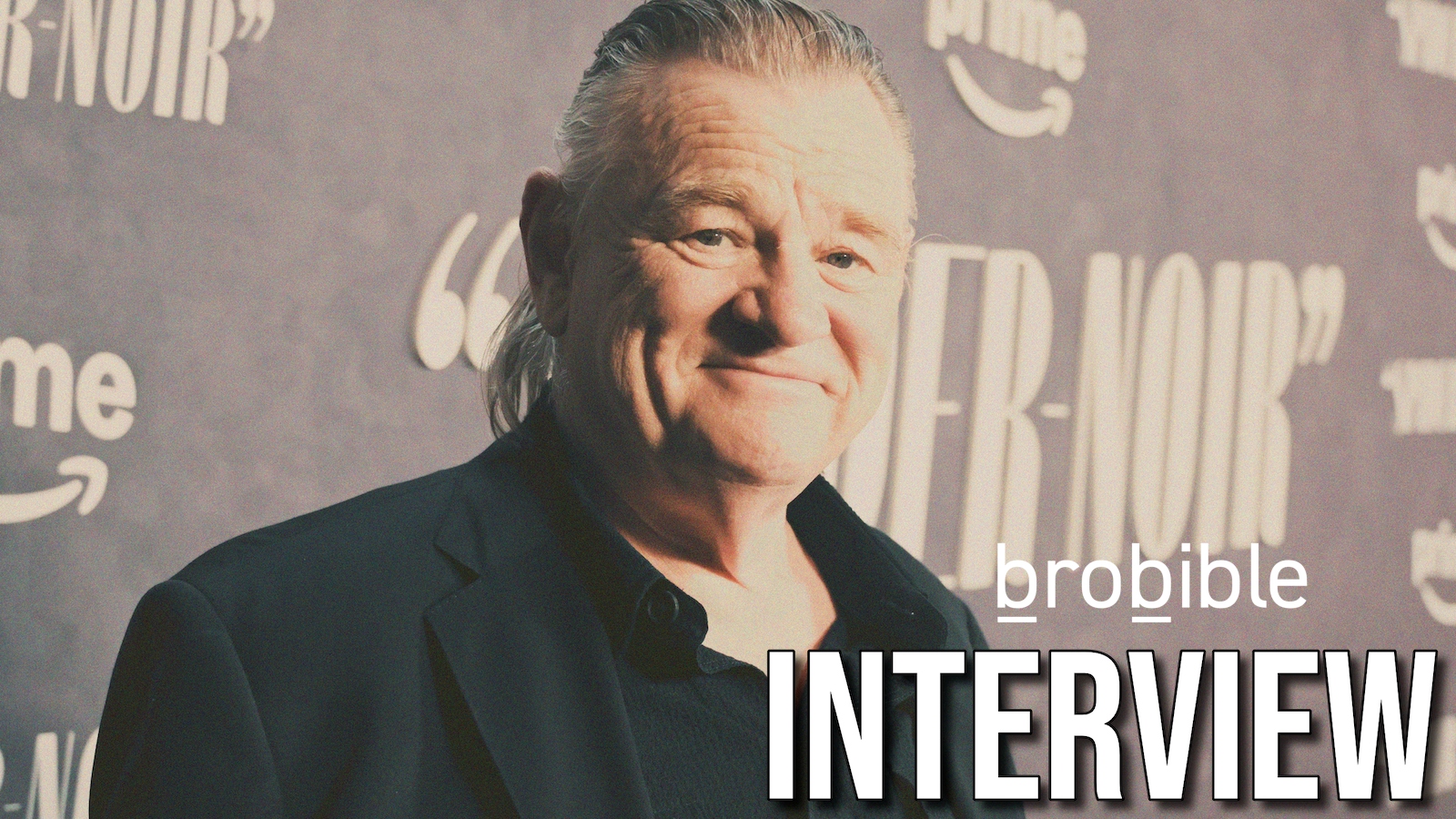
Kristina Bumphrey/Variety via Getty Images
My body is in Hawaii, but my brain is elsewhere: turn of the century New York City and the lush green hills of Ireland, to be exact. Despite the fact that I was on vacation in the Aloha State — half a world away from the comforts of my webcam and Zoom microphone, and mentally lightyears away from “work mode” — an opportunity to interview Oscar nominee Brendan Gleeson, genuinely one of my favorite living actors, was just not something I was prepared to let slip by, time difference be damned.
Fresh off the premiere of Spider-Noir in the city that never sleeps, legendary Academy Award-nominated actor Brendan Gleeson joined BroBible’s Post Credit Podcast to discuss playing Irishmen in old world New York City, the expectations and reality of working with Nicolas Cage, putting the “noir” in Spider-Noir, his iconic In Bruges scene with Ralph Fiennes and more memories from the beloved cult classic Martin McDonagh film, and more.
Brendan Gleeson on Spider-Noir, In Bruges, Gangs of New York, Irishmen in New York City, saying goodbye to his characters, and more!
https://youtu.be/5O7i6a0vYlc
ERIC ITALIANO, BROBIBLE: Folks, today I am thrilled to be joined by Brendan Gleeson for Spider-Noir, which hits Prime Video on May 27th. Sir, it is currently 7:30 a.m. in Hawaii where I am on vacation, but you are one of my favorite actors out there, so I had to make this happen. It’s a pleasure to speak to you today, sir.
BRENDAN GLEESON: Well, it’s a pleasure to speak to you out there. Looks like sunshine again.
EI: Always, every day. A bit too much, actually — I’m a bit burnt. So, I’m from New York, and they say the Irish built it. I noticed a connection between Silvermane and your Gangs of New York character Monk McGinn, in that they are Irishmen who turned themselves into forces of power in a rapidly evolving city. What about those two characters interests you?
GLEESON: Silvermane and… Monk. Yeah. You know, it’s kind of dog eat dog, right? Doing Gangs of New York was a fresh perspective for me. I knew the story that led to the Irish getting on the ships, but I was less aware of what happened when they hit the docks in New York. The riots, all of that — it was kind of news to me, really. I didn’t realize the city was on the verge of collapse with the kind of anarchy going on at that point.
So it was very interesting. Monk and Silvermane both arrived from a degree of chaos. With Silvermane, I wanted him to come from the tenements and slums of Dublin around the turn of the century, which were the worst in Europe at the time — the deprivation, the poverty. And then coming into New York, which had all those same challenges we saw in Gangs of New York, where people were living on top of each other in Hell’s Kitchen, Five Points, all of that. So it’s a similar world, and they both rose to prominence, as you say, by ruthlessness. Silvermane puts it down to pure courage — that in the end it was less about being wily. But I felt it was more that he had a degree of cunning and ruthlessness that went beyond what was normal.
What I found interesting was that Monk’s character had moved from violence — from being good at imposing violence on people — toward politics, and he died for it, because he sought to move away from that world. Silvermane, on the other hand, had the chance to fade blissfully into his dying years, and when he was given the opportunity to join a fight again, he couldn’t wait to get into it. He says things like, “Fighting makes me young. Fighting is the point.” He was very smart, very understanding of human nature and the politics of power — and I think that makes his cruelty all the more detestable, because he understood the consequences of what he did and had enough empathy to feel them, but enjoyed it anyway. Those are always the worst people — the ones who are fully aware of the evil they’re doing and still enjoy it.
EI: Is there something different about playing a villain under the noir tone and genre versus more modern genres?
GLEESON: Yes. I mean, it’s all tied together. I don’t know at what stage you can separate the films you’ve watched from how you play a character — you subconsciously inhabit a very particular world anyway. I was quite tempted to do Edward G. Robinson. I love him to death and was really tempted to go that way with it. But I became more interested in giving a kind of guy that wasn’t represented in those earlier films — giving him a life within the genre, even if it’s nearly a hundred years too late.
During shooting I sometimes thought, I should have gone full Edward G. with this. But on the other hand, I decided I wanted to go in a different direction, because a lot of what noir acting had to be about was a kind of blankness — a walling off, an enigma at the core of the character. Whereas I wanted Silvermane to be a little more emotionally engaged, because of the particular way he maintained his power. It was never driven by anger. It was never driven by hate. It was driven by an almost deliberate denial of those things. So I wanted to give him vivacity and life and an inner life that was quite visible — which in a way plays against noir, because you never really know what Bogart is thinking, or Edward G., or any of them. With this guy, you could be empathetic and say, “I get that” — but he acted as if none of it had any consequences. So I went against the genre in some ways.
But you cannot love the genre so much without being completely influenced by it. That hat was always going to happen. You’re going to look out from under the brim, you’re going to get the low angles, the Dutch tilts, the shadows, all of that — which is just so much fun to play. And because it’s a hundred years later and the technology has moved on and there’s a color version anyway, you have the license to push the envelope a small bit.
EI: I have to say, I tried it both in black and white and color, and I thought the black and white blew it away.
GLEESON: Me too. You see the color and think, ‘God, look at those costumes, look at that set’ — especially in the club, which was mostly my world. And then you go outside and… yeah. The black and white is much more appealing to me. I would have watched eighty percent of it in black and white, easily.
EI: I was genuinely impressed — I know it’s called Spider-Noir, but the commitment to being a true noir was real. The performance styles, the dialogue, the way it was shot — they really went for it, and I think it totally worked.
GLEESON: Me too. I think it’s a genuine achievement. And the color has its own thing — it’s genre color, that late-fifties Vertigo kind of palette. You haven’t left the era even in color. You’re looking at old postcards. You’re in a different world even in the color. It’s fascinating.
The expectations and reality of working alongside Oscar winner Nicolas Cage and his famously unique performance style
EI: You give such thoughtful answers you’ve been knocking out my questions. Nick Cage has a reputation that precedes him. What about working with him surprised you most, and did his performance style affect yours at all?
GLEESON: I think we were both encouraging of each other’s eccentricities. There was a tendency at the beginning to wonder — is this going to be a little too much? How far can we push things? But there was an understanding, shared by the showmakers, that this was a license. Nick had a great phrase: “70% Humphrey Bogart and 30% Bugs Bunny” — which was really funny, but there is a cartoony, larger-than-life aspect to this that you really do need to embrace.
It’s interesting — talking about Gangs of New York, most of the older actors in that film embraced a larger-than-life theatricality. “I can lick any son of a b—- in the house” — these guys embraced hugeness. Some of the younger actors were playing it very internally. It was an interesting mix. But in Spider-Noir I feel we got the tone right — there was an embracing of the theatricality of the era.
Working with Nick, we knew we had to maintain the integrity of the story and the reality that you can believe these characters as grounded people in a very specific city at a very specific time. But also — he swings from buildings on a piece of web. He’s a spider. There is no real “over the top” — over the top is the top of the Empire State Building. So it’s an incredible mix, and sometimes tonally it’s difficult. But I felt both Nick and I, and the different people who came in, had an innate understanding of where the tone should be, and we felt we could push it.
What surprised me — I expected his unpredictability and his commitment, whichever choices he makes. I was not disappointed in that. But he also wasn’t reckless. We’d talk, listen, ask: is this going too far? Are we having too much fun here? He has a real commitment not just to fearlessness but to making it work. That was the fun of it.
Memories of shooting his iconic In Bruges scene with Ralph Fiennes and the “honor” in his character Ken
EI: When did you first sense that this film [In Bruges] was going to stay with people? And looking back now, what do you think it is about Ken that has become something of a defining character for you?
GLEESON: I don’t know if it has — different people come up with all sorts of different things. But Martin’s writing… I’d done the short with Martin before, and my issues with Martin had been worked out. We’d gone for dinner before the short because I had questions about why he pushes the envelope to the places he does, and I’d been reassured that his work has legitimacy and integrity. So I was completely sure I wanted to work with him in pretty much anything he wanted to do. I’d seen all his plays. So when In Bruges came, I didn’t care whether it became a cult film or anything else. I wanted it to just be delivered.
When we went to Bruges for two or three weeks of rehearsal, I knew then. Working with Colin [Farrell], going through it — the city itself is so prepossessing. We knew we had an extraordinary setting, an extraordinary story, great characters, and Martin is very sure about what he’s doing. It was a question of realizing what we had.
Colin was going around most of the time in a state of semi-depression because of everything his character had done. He’d said he thought we were going to have fun making this film — and then he was living in that place. So we all knew this was a special piece of work. Honestly, we really did.
Theatrically, it wasn’t a big hit in Britain when it came out. People didn’t know how to market it. Then it found legs in America, went back, was re-released. It took a while for people to catch on, because nobody knew what it was. I remember seeing some of the trailers and thinking, that’s not really… but it’s very hard.
EI: The tone is so specific that it doesn’t translate to a two-minute trailer.
GLEESON: That’s exactly right. You say, ‘If you’re so smart, how would you pitch it?’ It’s really difficult.
EI: The scene with Ralph Fiennes. The context and content of the scene is deathly serious, and Ralph is wound up to about eleven — but there’s also an undeniable humor in what you’re saying to each other. What do you remember most about shooting that scene, and how did you two work out the tone together?
GLEESON: It was a no-brainer, honestly. What I remember most was that it was absolutely freezing. I was finding it hard to articulate. If you look closely, Ralph has little tears in his eyes — but that’s the wind. It was Baltic. You sometimes get so cold you can’t really speak properly. We had overcoats on but they seemed wafer thin in that wind. A really, really chilling scene — literally. But the dialogue is so good you don’t have to work at it.
EI: Your death scene is truly one of the most moving scenes I’ve ever seen in a film. From Raglan Road, to the way Ken has to push himself through the pain, to the way you look out over the skyline, the adjustment of the tie — what was your headspace going into that scene, and what were you most trying to achieve?
GLEESON: His honor. I think it was his sense of honor, in the end. He was a very interesting character — how do you reconcile being a hitman? But there was something dead in him, too. We actually shot a flashback scene that didn’t make the cut — the backstory of him losing his girlfriend, and Ralph’s character coming in and shooting the man who did it. The depth of Ken’s loyalty to Harry came from that. It didn’t make the film, but it was there underneath. In the death scene, there was always a sense of honor about Ken. I think he was dying to live up to it. Literally — that’s what he was doing.
And there’s that moment where his body comes down in the background of the shot, while Colin and the girl are talking in the foreground. They threw something off the tower — a big load of blood and guts. And the violence of it hitting the pavement from that height sticks with me, because after that I thought: I don’t know if I’d be able to speak after that. I have a few words after that fall, but… The word “chilling” keeps coming back to me.
EI: And then the reveal that the gun is broken — that’s just an absolute killer. I’ve got to wrap here, an we ask this of all our guests this: Of all the characters you’ve played, which one would you most want to go for a pint with? Is it Churchill — to give him a piece of your mind?
GLEESON: Absolutely not. (long pause) You know, a friend of mine — he doesn’t have much hair left now, but he used to say he was going to get his “wrap haircut.” Whenever he finished playing someone, he’d go get a haircut. Just to say goodbye to the guy, whoever he was at that time. I kind of feel that way. You say goodbye to these fellas and you let them sail off to become something else. I don’t feel as if I want to go for a pint with any of them.