



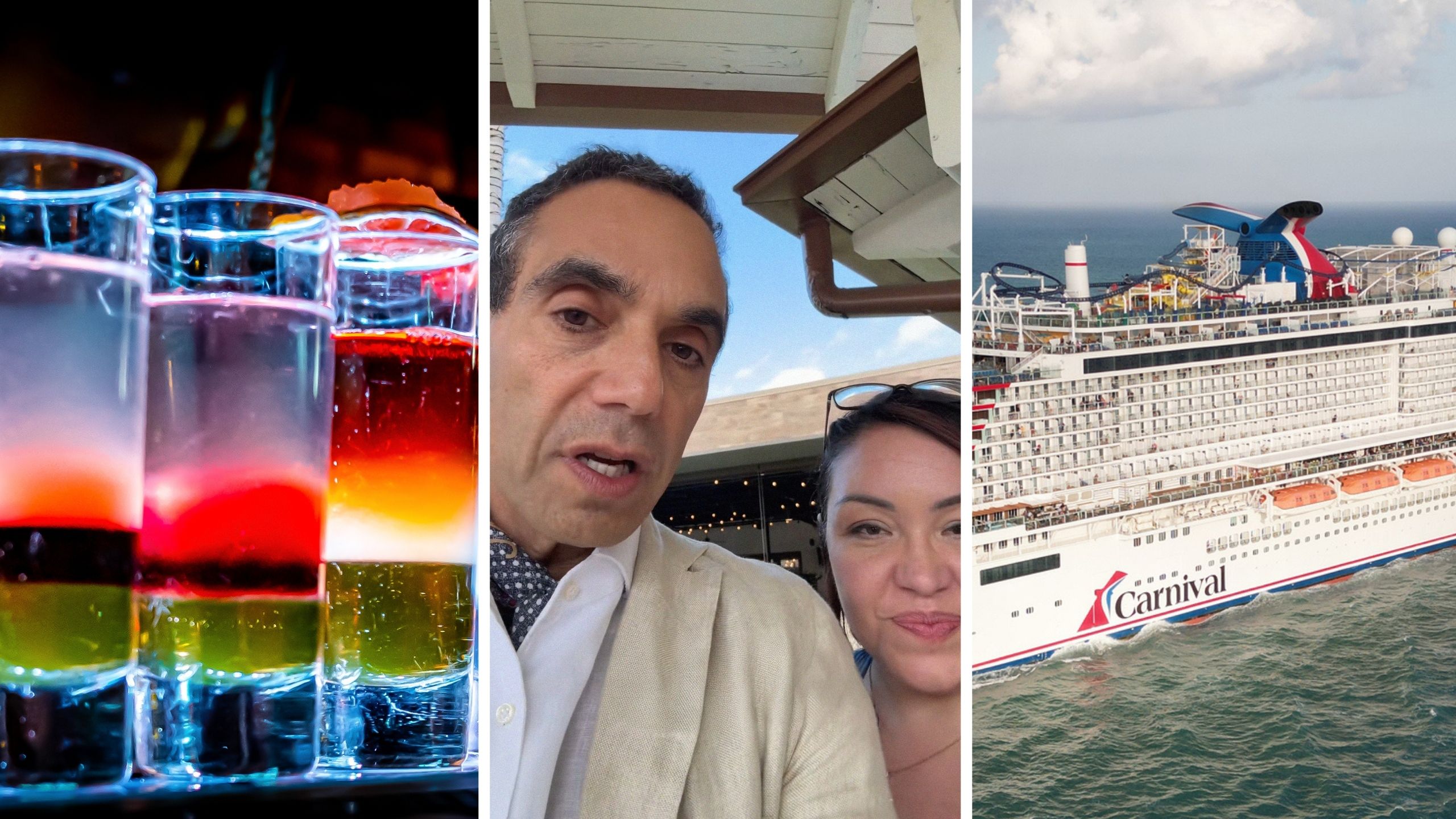
If you find yourself stumbling out of a bar, barely able to stand up, who’s fault is it?
Some may say that the blame lies entirely on you. After all, you’re the one who bought the hootch and drank it—who else could be at fault?
But, if you think about it, does the bar have any responsibility? They’re the ones who served an obviously intoxicated customer. Aren’t they even a little bit at fault?
That’s one of the questions that formed the basis of a recent court case against Carnival Cruise Lines. According to one TikToker, it resulted in a payout of $300,000.
What Happened On This Cruise Ship?
According to TikTok user and lawyer Spencer Aronfeld (@cruiseshiplawyer), his client, Diana Sanders, was a passenger on the Carnival Radiance. Aronfeld says that, over the course of eight hours, Sanders was served 15 shots of tequila.
Consequently, “she blacked out and woke up at the bottom of a staircase in the crew area,” Aronfeld writes in the caption of his video.
“Waking up after blacking out and going to the crew and asking them for help and asking them to tell me what happened was extremely frustrating,” Sanders tells the camera. “They gave me conflicting information. They treated me like a criminal.”
“I was very concerned that they wouldn’t tell me exactly what happened to me,” she continues. “And so I went to get a lawyer so I could get those tapes and find out what happened.”
The Trial Begins
According to the New York Times, Sanders had purchased Carnival’s “Cheers!” package. This allows customers up to 15 alcoholic drinks in a 24-hour period.
As a result of the fall, she says she suffered head injuries, bruising, and emotional distress, among other ailments. The resultant lawsuit claims partial responsibility for the consumption of alcohol, while also arguing that Carnival bore some responsibility for continuing to serve Sanders after she was visibly intoxicated.
“During discovery, we found that Carnival’s methods for tracking and monitoring alcohol service were insufficient,” Aronfeld wrote in an email to BroBible. “We believe the cruise line should better advise both servers and passengers by clearly printing the number of drinks served on receipts. They should also implement systems that prevent the immediate purchase of consecutive drinks.”
Aronfeld says that actually litigating the case under maritime negligence law took two years. During that time, Sanders says she “felt bullied.”
“I felt like everything they did was to either mentally torment me or financially torment me,” she says.
Not only that, but Aronfeld says that the video of the fall was never actually shown in trial.
“Carnival failed to preserve the most critical footage. While they provided hours of video from before and after the incident, the 30-minute window between Diana leaving the Casino Bar on Deck 5 and being found at the bottom of a staircase on Deck 0 was missing,” the lawyer wrote in an email to BroBible. “Carnival admitted they had seen the footage but claimed they did not think it was important to save.”
The Case Concludes
Eventually, the Miami jury came back with a verdict, awarding Sanders $300,000.
“I felt like the whole time, they saw right through what the defense was trying to do, how they tried to defame my character,” Sanders states.
“Diana’s compelling and credible account of her experience on the cruise was the most significant factor in persuading the jury. Her testimony, more than anything else, was the key to winning the trial,” Aronfeld added in an email to BroBible.
For their part, a Carnival Corporation spokesperson tells BroBible that it “respectfully disagrees with the verdict” and plans to appeal.
Why Are These Cases So Difficult?
In his video, Aronfeld says that “over-service of alcohol cases are extremely difficult.” But why?
To summarize, these cases are often hard to win due to the fact that it requires someone to be “visibly intoxicated.”
Various laws and statutes attempt to define this—for example, Missouri law says that, to be visibly intoxicated, one must be “inebriated to such an extent that the impairment is shown by significantly uncoordinated physical action or significant physical dysfunction.”
Given that many of these words are themselves ambiguous—reasonable people can disagree on what it means to be “significantly uncoordinated,” for example—people sued for serving alcohol to an intoxicated person can argue that, in their view, they weren’t “visibly intoxicated.”
Add in the fact that many cruise lines have strong legal contracts that make litigation difficult, and it becomes even more difficult to prove one’s case. This makes Sanders and Aronfeld’s win even more impressive.
In an email, Aronfeld also noted that “overservice cases are difficult because there is a reflexive tendency to blame the passenger. However, responsibility must be mutual. It is not just about responsible consumption, but also responsible service. Continually serving a visibly intoxicated passenger is wrong; the jury recognized this, which led to the successful verdict.”
Commenters Can’t Believe It
In the comments section, users voiced their support for Sanders, while others questioned the Carnival policies that led to this.
“Carnival really needs to modify the drink packages,” said a user. “Charging someone for a drink package that is equivalent to 15 drinks per day is going to encourage the consumer to get their money worth. & it’s just too much alcohol. It’s unsafe, especially on water.”
“Sounds like voluntary intoxication to me. however carnival does supposedly have people that are experts in monitoring guests when they’ve been drinking,” noted another.
“Shame on Carnival for over-serving a passenger after she should have been cut off. Why? For a few extra bucks? I am glad she won!” exclaimed a third.
@cruiseshiplawyer We discuss a significant legal victory in a case against Carnival Cruise Line. My client, Diana Sanders, a nurse from Northern California, was excessively served 15 shots of tequila over eight hours while aboard the Carnival Radiance. She blacked out and woke up at the bottom of a staircase in the crew area. After a frustrating experience with the cruise line’s lack of transparency and conflicting information, Diana pursued legal action. Despite facing a corporate giant and two years of litigation, a Miami jury of eight women ruled in her favor after five days of deliberation. We discuss how cruise lines have a responsibility to serve alcohol responsibly and not to repeatedly serve visibly intoxicated passengers, and how this verdict represents justice prevailing. #CruiseLine #Carnival #cruiseship #Alcohol #victory @carnival
BroBible reached out to Aronfeld and Carnival Cruises via email.