



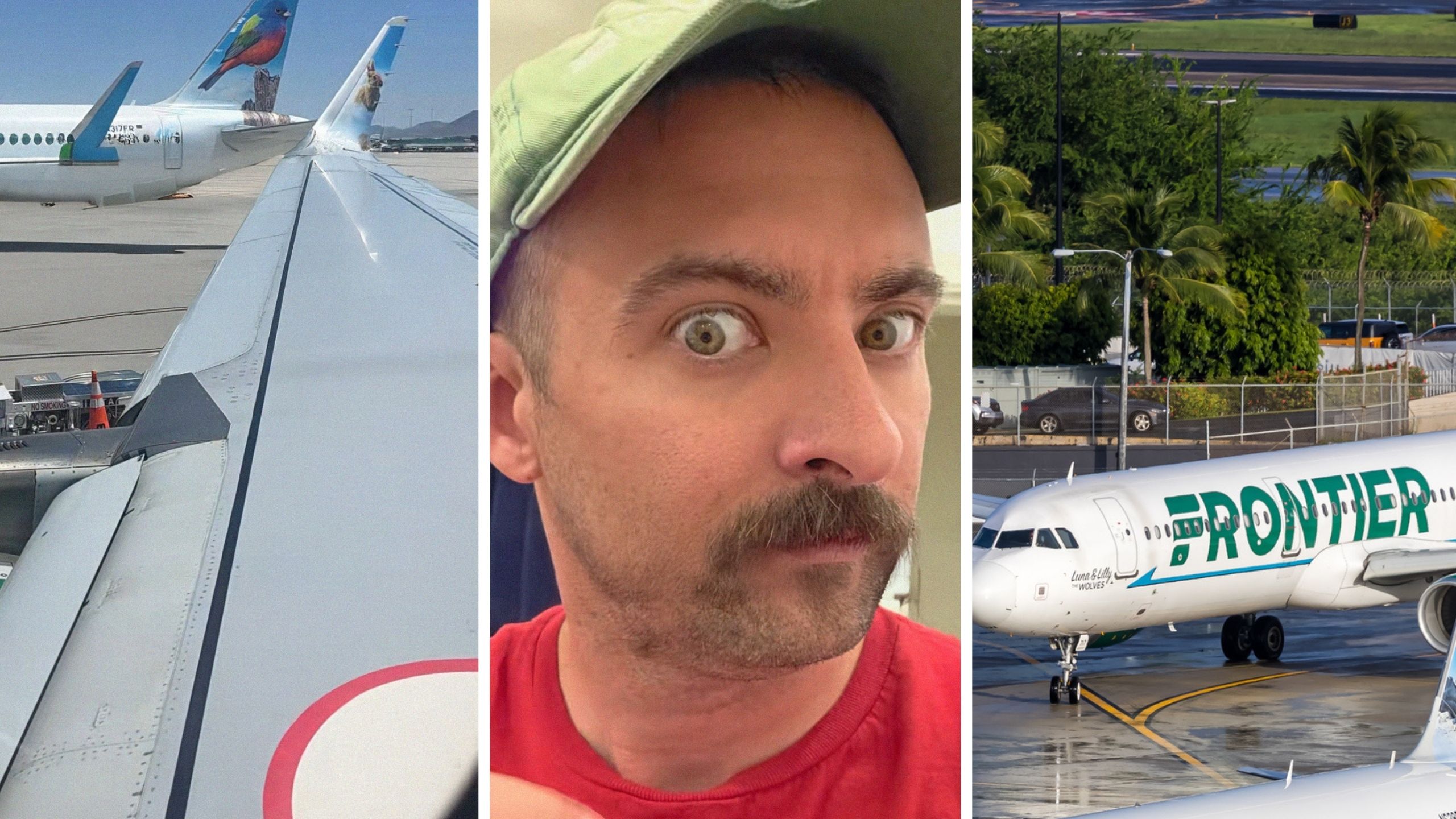
A man was taking a flight out of Las Vegas. Then he noticed a Frontier jet that he said was essentially a weather predictor.
Las Vegas aviation enthusiast CaptainRhyno (@captainrhyno), who works as a pilot and posts plane-related content, boarded a plane in his home city. He noticed that the flaps of a Frontier jet near him were positioned in a way that, to him, meant the weather had to be extremely hot.
“Flaps 1 on parking means you’re about to be sweating,” the content creator said. But what does that mean, and how is it a sign that it’s hot outside?
What Does ‘Flaps 1’ Mean?
In the video, CaptainRhyno posted a clear view of a Frontier jet. He zoomed in on one of the wings to show flaps on the airplane in a particular position. The TikToker said that the flaps were set to position “1” rather than a higher setting.
One commenter said, “Flaps 1 left down during hot weather usually if its +30 degrees Celsius to prevent false Air leak warnings on the A320.”
This is true for A320 aircraft. The planes have “air detection loops,” which are temperature sensitive. The official A320 FCOM says, “On ground, hot weather conditions may cause overheating to be detected around the bleed ducts in the wings, resulting in “AIR L(R) WING LEAK” warnings. Such warnings may be avoided during transit by keeping the slats in Configuration 1 when the OAT is above 30°C.”
That means that generally, A320 aircraft will have flaps set to the first setting when the temperature is above 86°F (30°C).
The Science Behind It
There’s another reason why the flaps might be an indication of the sweltering heat in Las Vegas.
When pilots fly, they have to adjust the plane based on environmental factors. Most airline pilots have to consider and even calculate exact numbers to take off, ascend, and descend.
Las Vegas has a higher elevation than most U.S. cities. In the summers, the city has a higher density altitude, which means pilots have to take special considerations when flying. The Aircraft Owners and Pilots Association says, “On a hot and humid day, the aircraft will accelerate more slowly down the runway, will need to move faster to attain the same lift, and will climb more slowly.”
Using less flap, such as “flap… 1,” in these conditions means the plane will drag less, thus making it easier to ascend faster. That can help account for the density altitude.
@captainrhyno flaps 1 on parking means you’re about to be sweating. #airlinepilot #aviation #aviationlovers #pilot #pilotlife
How The Aviation Industry Accounts For Temperature
In addition to adjusting flaps, the AOPA recommends that pilots “be sure the aircraft’s weight is below 90 percent of maximum gross weight,” and “Don’t fill the [fuel] tanks to the top.” Both of these tips are also part of flight management and are handled by individuals in the aviation industry.
Flight dispatchers, for instance, manage fuel consumption to improve flight safety and performance. Pilots go through rigorous checklists to ensure that each route is safe and traversable.
In addition, Harry Reid International Airport has specific measures it takes during the summer months to account for the heat in Las Vegas, which include adjustments to the airport terminal as well as adjustments to routes.
BroBible reached out to CaptainRhyno via TikTok direct message and comment.