



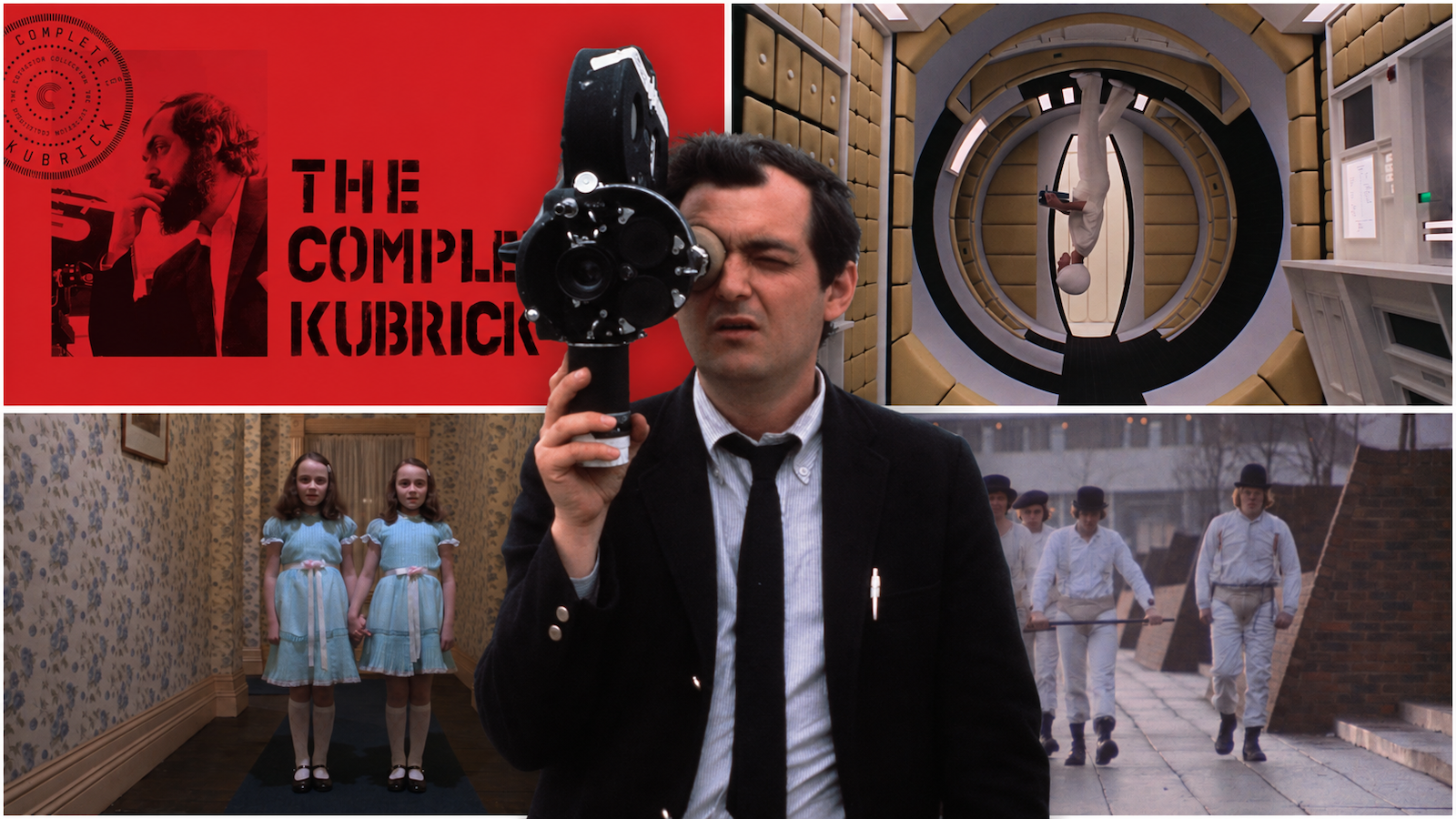
Sunset Boulevard/Corbis via Getty Images | Criterion Collection
BroBible spoke with Michael Chaiken, the producer of Criterion's Stanley Kubrick box set
If you say the word “Kubrick,” most people envision the same things: a symmetrical hallway, a black monolith, a perfectionist who never blinked. The name has become shorthand, the Kleenex of auteurs.
Michael Chaiken has spent about 20 years inside the archives of filmmakers, songwriters and novelists, including Kubrick’s and Bob Dylan’s. After months working on the new Kubrick 4K box set for the Criterion Collection — aptly titled “The Complete Kubrick,” releasing on October 20 — he came away with a different picture. In his telling, Kubrick was messier, funnier, and far more personal than the legend allows, and he built the cosmos in 2001 with eyedroppers and ink.
In our in-depth conversation with Chaiken, we spoke about how an archivist turns a vast collection into a story, where to start if you’ve never seen a Kubrick film, why Kubrick’s work gets called cold, what he thinks would have happened with A.I., and separating the man, the myth, and the filmmaker.
Living with the work of a filmmaking legend for over two years
ERIC ITALIANO, BROBIBLE: You’re probably doing tons of press this week, so it got me thinking — How does it feel talking about something that you already spent so much time thinking about?
MICHAEL CHAIKEN, CRITERION COLLECTION: “It’s surprising, in a weird way, because you’re hermetically sealed up in this world. Over this past week, it’s been dawning on me: okay, this is a reality. This thing is coming out, with all the work we’ve done. And it feels good. The cool thing is that, along the way and in talking to people, there’s just a lot of enthusiasm. I’ve never worked on a project quite like this one, and I’ve never been met with as much enthusiasm for one. I think that guided the project as a whole. All the different collaborators seemed very on board with this happening. These things are always jigsaw puzzles, but that made life a lot easier.”
How an archivist thinks like a filmmaker
These aren’t even in my notes; these are just things I’ve thought of as we meet. I was reading your interview in Deadline, and I believe you said that your primary job is as an archivist. How did that skill set translate to a filmmaker and a filmmaker’s works that are, like, *the* definitive archive?
“My main profession, if you want to call it that, is archivist. Over the past 20 years I’ve worked pretty closely with filmmakers, their estates, songwriters, novelists and other writers, but my background is largely in film. This project followed similar lines to previous ones I’ve worked on. I did spend some time in the Stanley Kubrick archive, which is vast. You could spend a decade in there and not get to the bottom of it.”
“The specific skills for something like this start with research, and organization is key too. When you jump into any of these archive projects, you’re functioning as an organizer, a researcher, and a bit of a diplomat, because you’re talking to all these different parties and stakeholders. When I come into a project, whether it’s Kubrick or the Bob Dylan archive, you’re creating a kind of husk around it, to give it order and some sort of narrative shape.”
“Generally, once you’ve organized or cataloged an archive, you have to get it out into the world. That might mean selling it to an institution, or donating it. But with an archive as vast as Kubrick’s or Dylan’s, you have to make it presentable and translatable. It has to make sense to the person you’re presenting it to. There’s a lot of editorial work in narrowing things down and cutting fat. You could go to any number of institutions and say, ‘Would you be interested in Bob Dylan’s archive?’ They’d probably say yes. But the next question is, well, what is it? Getting your head around that, and giving it some shape, is what I was able to bring to the Kubrick project.”
“It’s a little different with Kubrick, because his archive already has a home, at the University of the Arts London. So here it was about creating a through line, going through a lot of this material and building something coherent, with a narrative arc that could take you from the first disc to the very last without being too repetitive. Ideally somebody would get the set, start with the first disc, watch the films and the extras, and then move on to disc two.”
A box set built like a Library of America Edition
Is that how you suggest to go through it? Let me just say, it’s a gorgeous piece of work, physically.
“You could go through it that way, and I think if you go slow and take your time with it, it’s rewarding.”
Is that how you did it?
“Sort of. Any of these projects are like jigsaw puzzles. You have the films, but then you have to figure out what’s going to surround them and add some additional context. Things fall into place when they fall into place. Some never do, and some fall into place at the 11th hour, which was the case for a few of the pieces in the set.”
“But I generally thought of it as chapters. My North Star was the Library of America editions. They’re a great series, and they take a particular writer. There was a recent one on Jim Thompson, who worked with Kubrick, edited by Robert Polito. They present all the major works, but in between they include additional material, whether it’s correspondence from the period, an early draft, or some unpublished piece, to give the finished work more context. That was my North Star for the Kubrick set. I thought of each disc as its own edition, its own universe, and they connect. If you want to go from the first disc to the last, you can do that like you’re reading a novel. Of course some people are going to say, ‘I want to see The Shining,’ or ‘I want to see the new restoration of 2001.’ There’s no right way.
“It very intentionally ends with Stanley’s own voice. The last documentary on the last disc, Kubrick by Kubrick, is narrated entirely by Kubrick. It was pulled together from interviews he gave over the decades to a French film writer named Michel Ciment. It ends with his voice, and that was very intentional.”
The turning points in Kubrick’s defining career
You bring up chapters. Did you see each film as its own chapter? I guess the question I’m trying to get towards is, what were the moments in Kubrick’s career that you could mark as a true evolution or turning of a corner?
“That’s a good question. Every film he made was an advance on the one before it. But certain films projected him into a completely different realm. You have to begin with the first short film he made, Day of the Fight. For the first time, we were able to present his original cut in 4K. We restored his original version. It’s about a boxer named Walter Cartier. Stanley started as a photographer for Look magazine; Walter was one of his subjects, and he turned the story into his first film. That’s his move from photography to filmmaking, so it’s critically important.”
“There are amazing films in between. The Killing. Paths of Glory, which put him in a position where he could direct something like Spartacus. And I’d say Spartacus is hugely important in his career. He didn’t have much respect for it, because he was working within the studio system and didn’t have final cut. But it’s the moment where he says afterward, ‘I’m not working like this again.’ He begins working in England, as far away from the studio system as you could possibly get. Even though it was a very successful film, it was a very difficult experience for him, and it completely changed how he controlled his own work. It also gave him a huge amount of freedom, because the film was so successful, as were his next ones, Lolita and Dr. Strangelove.”
“So, Day of the Fight, Spartacus, and obviously 2001. Our received wisdom about Stanley Kubrick comes largely from 2001, and it put him into a rarefied category.”
Is “Kubrickian” an actual thing, or a myth?
Now seeing it in 4K, it’s just stunning to consider — it was stunning even before the 4K, of course — but to consider when it was made. 2001, as you rightly point out, is just a massive turning point in his career and cinema as a whole. But Kubrick, to me, has become so ubiquitous and so omnipresent that he’s like Kleenex, right? Some people don’t know that Kleenex is a specific brand. They just think tissues *are* Kleenex. And Kubrick seems to have a larger-than-life mythic quality where the idea of him is understood, but not the specifics. If I say Lynchian, people have an idea of what that is. If I say Scorsese, people think of the tangible, physical hallmarks of what he did with his craft — the freeze frames, voiceover. So, what are the actual tangible foundations of Kubrick’s filmmaking?
“That’s an interesting question, because each film is so different from the others in scale, scope, the way they look, the way he shot things. They’re radically different, but all of them bear his imprint. There are thematic imprints. Most of the films have something to do with men dissembling in some way. And there are certain shots that have become synonymous with Kubrick, like the one-point perspective shot, which you see throughout his films, going back to the early shorts, and the long zooms in and out.”
“But when people say ‘Kubrickian,’ it means different things in different situations. People talk about the ‘Strangelovian’ effect, and they’re talking about politics. They’re using that specific Kubrick film to make a point or a metaphor about some political situation. I don’t think there’s a single defining characteristic. There are just certain hallmarks.”
Is that it though?
“I think our received wisdom about Kubrick comes from two things. One, the films have become so monumental that, as you said, they’re part of the air we breathe, and they’re referenced constantly. The other is how private a human being Kubrick was. He didn’t do film or television interviews. He did some written interviews with critics he liked and trusted. That mythology, combined with the enormity of the films, has given him an almost secular-religion quality.”
“His relationship with his own fame was very different from other filmmakers at his level. He was on the cover of Newsweek in the early ’70s and people still didn’t know what he looked like. He worked at home, he loved being at home, and he didn’t travel. And as his career went on, the gap between films got longer and longer, so the anticipation just kept growing. For some people he’s almost a religious figure, and that’s both good and bad.”
Where to start if you’ve never seen a Kubrick film
Not that this really matters to the conversation, but just to share my perspective: I am not a religious person, but I imagine that, whether you are or aren’t, going into a new church for the first time is an intimidating thing. In that sense, Kubrick’s mythology — he’s almost a monolith himself — makes his work feel impenetrable. Let’s say you’re a 43-year-old mother of three and the only films you’ve seen in the last 10 years are in the Frozen franchise. Where and how would you recommend they start to understand Kubrick’s work without it feeling like, like you’ve said, a mythic undertaking?
“I’d probably recommend some of the earlier work, like The Killing and definitely Paths of Glory, when he was becoming the Kubrick who would go on to direct 2001 and The Shining. He’s a very young man there, and his ideas are still coming together, but you start to see the evolution of his storytelling and his cinematic technique. There’s no war film that looks like Paths of Glory, and it’s a very moving film. There’s a humanist streak in it. There are a lot of people for whom these films leave them stone cold, but Paths of Glory gives you an entryway. If you’re taken by it, it’s a good place to say, ‘Okay, I’m going to go forward with this.’ Throwing someone in the deep end would be 2001 or A Clockwork Orange. That might take a little warm-up.”
The “Cold” Critique
Having familiarized yourself with his work to such an extent, where do you land on that cold critique? That’s something Chris Nolan dealt with for a while, and it’s hard not to draw a line between those two, especially seeing where Nolan is continuing to go. I’m obviously well more versed in Nolan than I am Kubrick, but rewatching some of his earlier films like The Prestige and Inception, I don’t find them cold at all, and I struggle to understand where that perception came from. Is it a misunderstanding of Kubrick’s work? Where did you land on that?
“That’s a good question. I don’t think it’s a misunderstanding of Kubrick’s work, but I think there’s another side of the equation that isn’t being fully felt. Having spent all this time in his world, talking to people who worked with him, talking to his family, watching the films over and over: yes, there’s a side of his films that takes a very cold, sober eye. But it’s also comedic. I think all of his films are comedies. They’re nightmare comedies, but they’re comedies. There’s a part of him with a cool eye on the way we live and the way people treat each other, all the issues of modern life. But if you’re immediately repelled by that, you’re missing the more playful, humorous side. I hate to say ‘warmer,’ because I don’t want to make Kubrick into a teddy bear. It’s a more humanist side to his work.
The best way to see it is to listen to his contemporaries speak about him and the way he spoke with them.
“I think that’s true. The thing that surprised me most, watching these films again and again, is that the films are a lot messier than people attribute to Kubrick. They were unfolding as he was making them. He made them collaboratively, with the actors and with his cinematographer, and he was constantly searching. It wasn’t a cold perfectionism from the outset. He set up these situations, he pushed, and he searched for ideas.”
“The films are also inscribed with a lot of personal material. I never fully realized how personal they were. I wouldn’t call Stanley Kubrick an autobiographical filmmaker, but his family is all over his films. His wife’s paintings are all over them. He put his children in his films, and he’s in some of them. I don’t want to give it away, but he’s in 2001 in a way that’s profoundly personal. It was deeply moving to me when I learned about it. If you listen to Michael Benson’s commentary on 2001, he talks about it. Something like Eyes Wide Shut is a very personal film for a lot of reasons. I think that side of Kubrick is overshadowed by the received wisdom of him as a cold, distant master.
“If you talk to the people who really knew him, and to his family, it’s impossible. The people he surrounded himself with are so funny and smart in their own way that Stanley wouldn’t surround himself with people like that if he were that far removed. He had a wicked sense of humor. The films are nightmare comedies, but they’re comedies nonetheless, and there’s a humanist strand in Kubrick’s work. I don’t want to put too fine a point on it, because I don’t want to make him sound like some sort of hippie. But it’s there, and you don’t have to scratch that hard to find it. I hope the box set helps bring that forward.”
“That said, Full Metal Jacket is a hard film. It’s a cruel film, and tough for a lot of people to take. Kubrick had a great line: ‘It’s not the bullet that kills, it’s the hard heart that kills.’ I agree with that.”
What the Films Taught Him
Were there any core beliefs, either about Kubrick in general or any one of his specific films, that you either believed going into it and had rewritten by the end of it, or discovered during the process?
“It goes back to what we were just talking about, the way he inserted himself into these films. They’re not on-screen cameos like Hitchcock, who put himself in every one of his films. But Kubrick’s fingerprint is there. Take 2001. You think of it as this technological wonder, which it absolutely is, but there’s also a very handmade quality to it that I find very moving. In the Stargate sequence, where Bowman goes through the Stargate into Jupiter, the first movement is all this very complex slit-scan, where you’re moving through space. The second movement is all handmade, using oils and dyes and inks. These were experiments Kubrick did himself. They were some of the first things he shot for 2001, and they led to that sequence.”
“So you think about the models and the ingenuity of that film in terms of effects. But then you think of Stanley with a mask over his face, dropping ink into a giant fish tank, letting off all these fumes, and filming it with a 65-millimeter camera. For all the technology, the idea of him standing over a giant vat of banana oil with eyedroppers and inks, creating the cosmos, is just awesome. That handmade quality surprised me the deeper I got into the films.”
A.I. and the Spielberg Handoff
We only have a few minutes left here. This is a bit of a personal question, because it’s not actually about a movie that’s on the box set, but considering you’re a Kubrick expert, for lack of a better term, you’re as good as anyone to ask. It’s about a film of much personal reverence and fascination to me, and I think to many at large, and that’s A.I.: Artificial Intelligence [Steven Spielberg, 2001]. I would love to hear any insight, or anything that fascinated you about Kubrick’s work on that project: why he decided to pass it on, how the handoff worked, the vision he had for it, and so on.
“The most fascinating thing about A.I., when I started, was how far back that project went, as far back as the mid-to-late ’60s. It started with a short story he read, ‘Super-Toys Last All Summer Long.’ It grabbed him, and it was in the back of his head, very similar to his last film, Eyes Wide Shut, which he’d wanted to make as far back as the late ’60s too. It’s a thread that winds throughout his entire archive. He was developing it simultaneously with Eyes Wide Shut, and had Kubrick lived, it’s very likely it would have been his next project. Whether he’d have directed it or not, who’s to say.”
“I think toward the end of his life he resigned himself to the idea that Spielberg would be much better suited. It goes back to what we were talking about: Spielberg would give it a warmth and a popular appeal that Stanley felt Steven was much better suited for.
“I did a lot of research on Eyes Wide Shut, and it was very cool to see in his archive that the Eyes Wide Shut storyboards were happening at the same time as the early A.I. storyboards. A lot of those storyboards came to fruition in the finished film. How long these projects gestated is astounding. It’s a great film, and an important one.”
Great movie.
Kubrick, Football and the Movie That Never Was
“You’re primarily a sports website?”
Our website is, yeah, but I do our film and TV coverage. But I’m a huge sports fan as well, personally.
“Kubrick was a huge sports fan. He loved American football. His friends in the States would send him videotapes of games, and he’d watch them religiously. He’s quoted somewhere as saying some of these games were more dramatic and exciting than most of the movies being made.”
Wow. I can’t imagine him doing a sports film. ‘Stanley Kubrick’s Remember the Titans.’
“It would be absolutely amazing. You can see where the drama would appeal to him, and probably the way a lot of these games are shot would be very appealing to him too.”
One Last Detail
And quickly, is the yellow inner box meant to look like some kind of nuclear code book?
“A little bit, yeah. There’s an army-surplus nature to Stanley Kubrick’s archive. A lot of the text on the outside, the stencils, his name stenciled on things like that, and some of his scripts have the same army-surplus typeface. He also walked around in an army jacket for the last 15 years of his life.”
Thank you, Michael. Beautiful work you’ve done.
“I appreciate that. Thank you. Good talking, Eric.”
The Complete Kubrick from the Criterion Collection will be available for purchase beginning on Tuesday, October 20.