



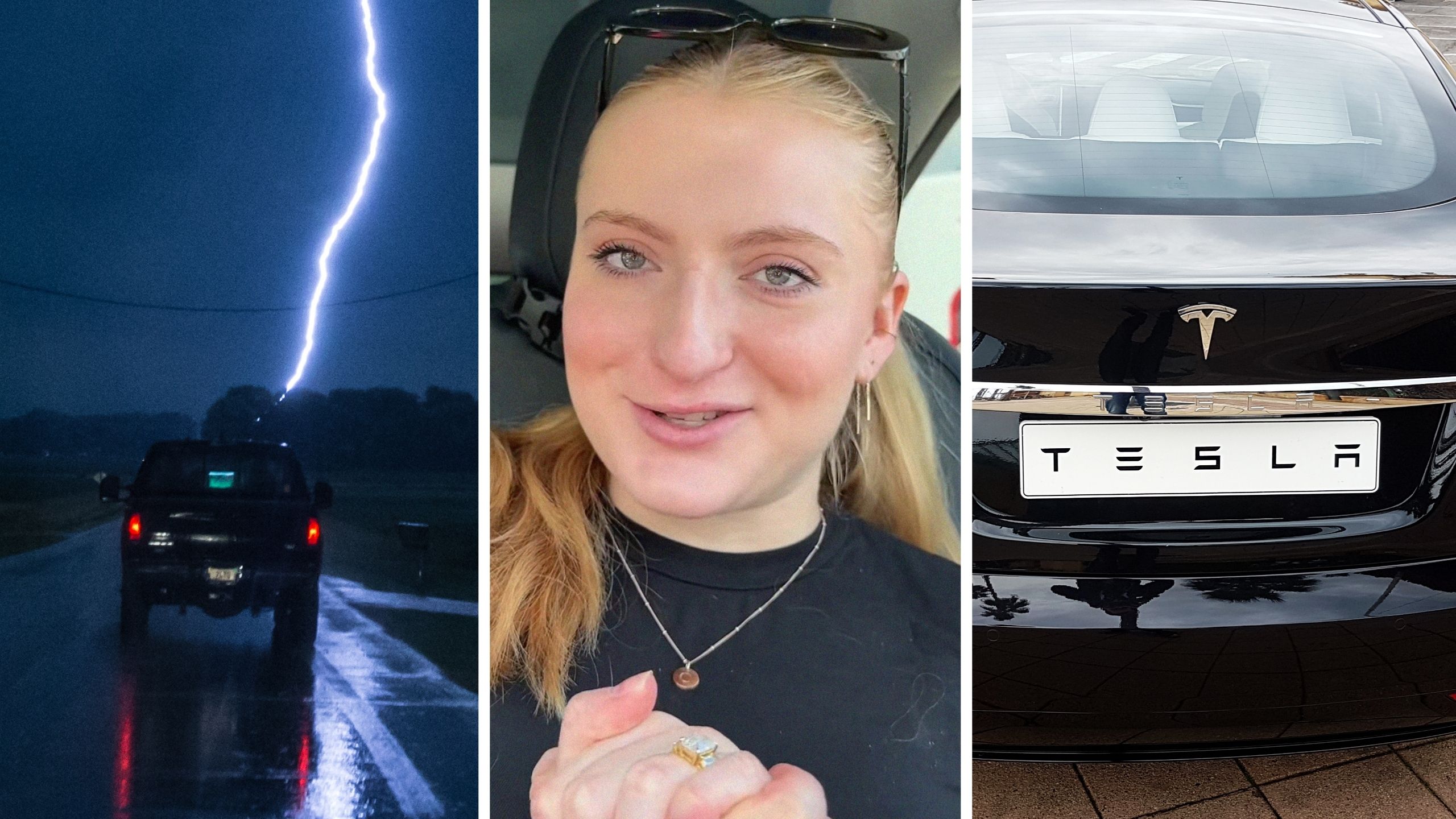
There goes the age-old myth that you can’t get struck by lightning while in a car.
This pregnant woman and her husband got the shock (pun unintended) of their lives when he was driving and his car antenna suddenly got struck by electricity.
Here’s how he fared in it all.
Truck Struck By Lightning
In a TikTok with more than 48,000 views, content creator Hannah Strauss (@hannahgstrauss) shared the terrifying experience her husband went through.
“My husband just got struck by lightning,” she says at the top of the video. “Literally. Well, his car technically.”
Strauss explains that her husband’s truck was struck by lightning on his way home from work, and the Tesla behind him caught the whole thing on its dashcam.
Strauss adds that the strike fried the car from the inside, totaling it, and her husband had no idea what was happening when it hit.
“Apparently, it was super loud,” she says. “His hearing for the whole rest of the day and today has been way off.”
Paramedics were called and cleared him, though cops on scene were visibly stunned he made it out. At one point, Strauss says, her husband jumped out of the car because it felt like it was exploding; his antenna blew apart and scattered across the freeway.
“Apparently, if you jump out of your car after it gets hit by lightning too quickly, the electricity cannot be grounded yet and can kill you instantly when your feet touch the ground,” she says.
At the end of the video, she shows the Tesla dashcam footage plus the truck getting towed to their driveway.
Strauss adds that she’s 39 weeks pregnant, and says the stress of the whole ordeal may push back her due date.
“He texted me, ‘I got struck by lightning,’ and I just about lost it,” she says.
“Literally what are the odds?! Very, very, very grateful he’s alive to tell the tale,” she says in the caption and mentions a potential storytime video from her husband, but hasn’t posted one yet.
Are Cars Actually Safe From Lightning?
Yes, if you’re inside a hard-topped metal vehicle with the windows closed, but not for the reason most people think. The rubber tires myth has nothing to do with it.
It’s the car’s metal body that offers protection, not the tires. The Zebra explains that the metal frame creates what’s known as a Faraday cage effect, channeling the electrical current around the occupants and through the tires to the ground. The same principle applies to electric vehicles; driving a Tesla or any other EV in a thunderstorm carries no greater risk than a gas-powered car, as long as it has a hard top.
The car itself, however, is a different story. According to the National Weather Service, a lightning strike typically hits the antenna or roofline of a vehicle, passes through the outer metal shell, and exits through the tires to the ground. Common damage includes a melted or destroyed antenna, fried electrical systems, shattered rear windows (caused by the small defrosting wires embedded in the glass), and blown-out tires from the electricity passing through the steel belts. In severe cases, the strike can ignite a fire that totals the vehicle entirely.
Western National also flags an important safety note for anyone whose car gets struck while they’re in it: don’t touch any metal inside the vehicle. That means the steering wheel, door handles, radio, cell phone chargers, and GPS devices are all off-limits until the situation is assessed.
Lightning Myths, Debunked
While we’re at it, The Zebra breaks down a few other common lightning misconceptions worth knowing:
- Rubber tires protect you from lightning. False—as covered above, it’s the metal frame doing the work, not the tires. Rubber provides negligible protection against a bolt carrying hundreds of millions of volts.
- EVs are more dangerous than gas cars in a lightning storm. False. The Faraday cage principle works the same regardless of what’s powering the vehicle. Hard top, windows up, you’re fine.
- Lying flat on the ground keeps you safe if you’re caught outside. Actually the opposite. When lightning strikes the ground, electric current branches outward in a tendril pattern and can be fatal up to 100 feet from the strike point. The more of your body touching the ground, the worse off you are.
- You’re completely safe from lightning inside your house. Not quite. You’re much safer, but lightning can travel through corded phones, electrical wiring, metal plumbing, and connected appliances. Cell phones are safe; landlines are not. Even your TV or computer during a storm can provide a pathway.
- Insurance won’t cover lightning damage. Standard homeowners insurance does cover lightning strikes to your home, structures on your property, and fires caused by strikes. For your car, you’ll need comprehensive coverage; collision-only or liability-only policies won’t cover it.
People Had No Idea It Was Possible
“So it was a lie that we’re safe in a car because of the tires?” a top comment read.
“Omg new fear brooo,” a person said.
“Play the lottery,” another suggested.
@hannahgstrauss Literally what are the odds?! Very very very grateful he’s alive to tell the tale ♥️ Let me know if you want his storytime because he has all the details obviously #lightningstrikesurvivor #lightningstrike #crazystorytimes #freakaccident #storytimestiktok
BroBible reached out to Hannah Strauss for comment via email and Instagram direct message.