



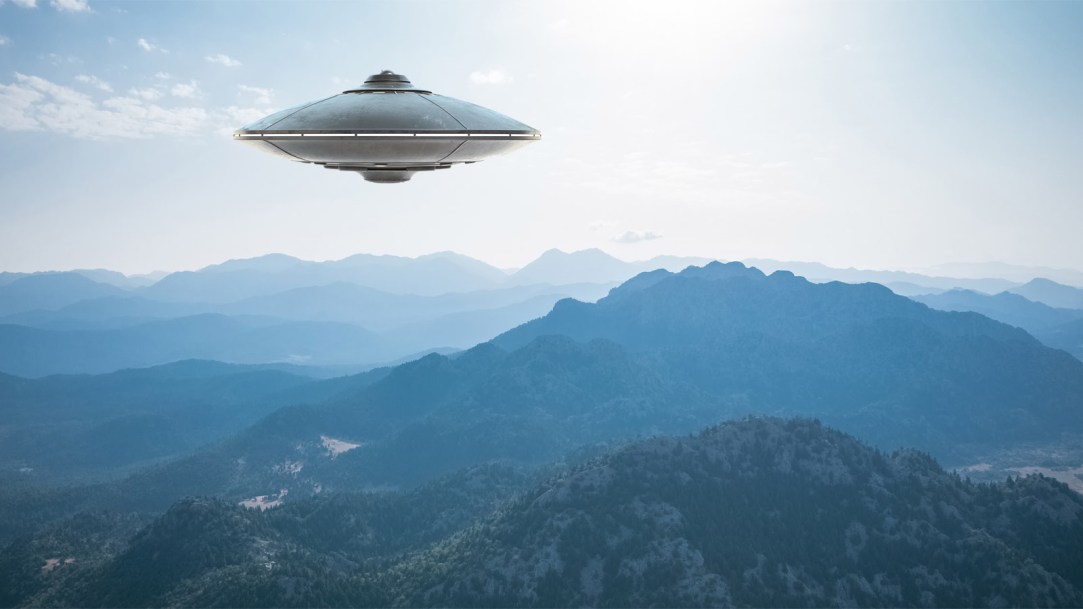
From at least the 1970s to the 1990s, the CIA spent millions of dollars researching the claims of “psychic spies,” also known as remote viewers, much of it for the U.S. government’s Stargate Project. They were part of a program that conducted experiments using people who claimed they could see distant or otherwise unseen subjects using only their minds.
Over the years, they have claimed to have seen proof of life on the planet Mars, a secret complex of towers and buildings on the moon’s surface where the aliens worked, the location of the Ark of the Covenant, and the locations of several alien bases.
Now, another one of these CIA “psychic spies” claims to have uncovered the coordinates of four more alien bases located inside multiple mountains. People often claim that secret alien bases are located underwater, in the Arctic, or inside mountains or volcanoes.
Lyn Buchanan, a decorated Army intelligence veteran, made this claim recently on Jesse Michels’ American Alchemy podcast.
He claimed that aliens hid their bases deep beneath remote mountain ranges. They supposedly serve as cosmic transit points, interplanetary surveillance hubs, and UFO maintenance depots.
Mount Hayes in Alaska, Mount Zeil in Australia, Mount Nyangani in Zimbabwe, and a site in the Pyrenees Mountains along the Spanish-French border were the four main targets that Buchanan says he was assigned to monitor using his unique skill.
What are these aliens supposedly using these bases for?
According to Buchanan, the Mount Hayes alien base was used for global surveillance and “keeping intelligence on the Earth.” He claimed “the equipment was now automated,” so “there was no need for personnel there.”
He claimed that aliens used Mount Zeil as an airport. “Mount Zeil is sort of a port of entry to the Earth that friendly ones go there and then from there spread out around the world,” he said. He added that the site is heavily protected, and if “you see too much, you disappear.”
He also described Mount Nyangani as a specialist maintenance facility for UFOs. Buchanan said he never did view the site in the Pyrenees.