



REUTERS/Lee Smith TPX IMAGES OF THE DAY/REUTERS/Carlos Barria/Vincent Carchietta-Imagn Images
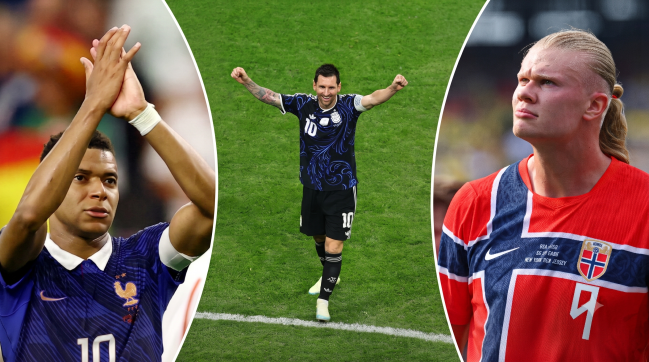
A collage of images featuring France's Kylian Mbappe, Argentina's Lionel Messi, and Norway's Erling Haaland at the 2026 FIFA World Cup
Barring the rules of soccer changing immediately or something unlike we’ve ever seen before, Lionel Messi is going to leave the 2026 FIFA World Cup as the tournament’s all-time leading scorer.
As it stands, Messi holds the record with 21 goals after overtaking Germany’s Miroslav Klose earlier in the tournament, and he could well add to that tally in the final against Spain on Sunday.
However, there’s no guarantee that he holds onto that record forever. in fact, he could well lose it as soon as 2030 should he not make the incredible decision to play for Argentina at the age of 43.
So, which players have the best shot to overtake Messi as the king of World Cup goals? Well, No. 1 on our list feels like a given. However, he’s not the only player with a chance.
We’re counting down the seven players with the best shot of overtaking Lionel Messi as the FIFA World Cup’s all-time leading scorer.
7) Endrick – Brazil
At the moment, Endrick has precisely zero World Cup goals, which makes this, by far, our boldest prediction on the list.
But hear us out for a moment. At just 19 years old, Endrick is considered the future for Brazil at the striker position, even if current manager Carlo Ancelotti seemed so reluctant to play him that it turned into a meme.
However, there’s no denying his talent.
After a year on loan where he scored five times for Olympique Lyon, Endrick is set to return to Real Madrid this summer under new manager Jose Mourinho.
If he can take the next step in his development, he could well lead the line for Brazil at the next three World Cups, and with seemingly ever-expanded fields leading to more games against lesser teams, he could rack up the goals in a hurry.
6) Lamine Yamal – Spain
Like Endrick, Spanish superstar Lamine Yamal has age on his side at just 19 years old, and he’s one step ahead of his Brazilian’s counterpart after scoring for Spain against Saudi Arabia in the group stage.
Lamal could well add to his own personal tally in the final against Messi and Argentina as well.
What may well prevent him from making a true push for Messi’s record is the fact that he plays out on the wing and is known more for being a creator than a true goal scorer. That being said, the same was true of Messi, who was also playing for Barcelona at the time, when he was 19 years old.
Is it likely Yamal will catch or pass Messi? No. But is it possible? There’s no reason to believe otherwise.
5) Vinicius Jr. – Brazil
The second and final Brazilian on our list is Brazilian superstar Vinicius Jr., who already has five goals to his name and is increasingly becoming a goal threat both for the Seleção and for his club, Real Madrid.
What’s working against Vini Jr. is the fact that he would likely need to have two absolutely incredible World Cups in order to even have a shot.
At 30 years old, he’ll likely be on the back end of his prime come the 2030 World Cup, and then he’ll need to replicate that performance at 34 years old in Saudi Arabia come 2034.
Now, Messi is still out here winning the Golden Boot at 39 years old, so it’s not impossible Vini Jr. could play three more World Cups, but you wouldn’t bet on it.
4) Harry Kane – England
This one may come as a surprise to many readers, because at 32 years old, Harry Kane may well have already played his final World Cup game for the Three Lions.
But hear us out a minute.
Kane’s style of play is one that could age extremely well, and he currently sits on 14 goals, just seven behind Messi, after scoring six goals in the 2026 World Cup.
While you may think Kane is likely to miss out on the 2030 World Cup, when he will be 36 years old, it’s not quite that clear.
Consider the fact that Liam Delap, Eddie Nketiah, and Dane Scarlett are the only English strikers with at least one appearance in a top-five European league this season who will be under the age of 32 come the next World Cup, and none of the three were impressive.
So it’s extremely possible England could still be leaning on Kane come 2030 if his body holds up.
3) Jude Bellingham – England
If Kane is not the best option for England come 2030, and no young striker develops, you could well be looking at a situation where the best option is to play superstar Jude Bellingham up top.
The Real Madrid star just turned 23, so he’s likely to play in at least two more World Cups for England, health willing, and he was clearly the Three Lions’ best player in this tournament.
Bellingham, playing in an attacking midfield role, scored six goals at the 2026 World Cup, adding to the one he scored in 2022 in Qatar.
His physique, athleticism, and sense around the box make him a prime candidate to adapt to a false nine role, especially when you consider that England has players like Cole Palmer and Phil Foden, both of whom were left out of the 2026 squad, to fill the role in behind the striker that Bellingham often played in this summer’s tournament.
Given his age and ability, it would be a mild surprise if Bellingham didn’t at least threaten the current mark held by Messi.
2) Erling Haaland – Norway
Erling Haaland has a few things working against him in his quest to catch Lionel Messi’s record. For one, at 25 years old, the odds are he only plays in two more World Cups.
Additionally, while Norway is currently experiencing a “Golden Generation,” there’s no guarantee that they qualify for both the 2030 and 2034 World Cups, let alone advance far enough for Haaland to rack up the goals.
On the other side of the equation, Haaland is the best goal poacher in the game right now, and that figures to be the case again come 2030. Norway has surrounded him with creative attacking players such as Antonio Nusa and Oscar Bobb, and he doesn’t need a ton of chances to convert them into goals.
Haaland scored seven goals in just five matches at the 2026 World Cup, putting him on pace to potentially catch Messi by 2034.
1) Kylian Mbappe – France
This one feels more of a matter of “when” than it is “if.”
At just 27 years old, Kylian Mbappé has 20 FIFA World Cup goals, only one fewer than Lionel Messi despite having played in 12 fewer matches.
Mbappé, like Messi, serves as the attacking focal point for an absolutely loaded French team that is likely to be just as talented in 2030 as it was at the past few World Cups, where it has finished no worse than fourth and reached a pair of finals.
Mbappé is still likely to be the starting striker for the French come 2030, barring an injury that forces him out of the tournament. And if that’s the case, you’d wager a good amount of money on him getting at least one goal to tie Messi, and probably more to pass him.
Perhaps Messi scores in the 2026 final against Spain to extend his lead, but Mbappé taking over the crown as the World Cup’s all-time leading scorer feels inevitable.