



Jim Davis/The Boston Globe via Getty Images
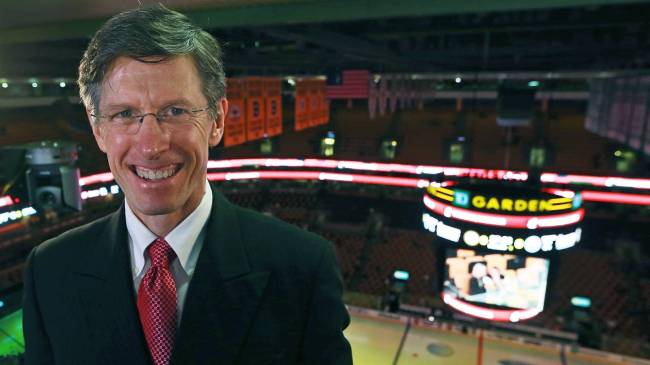
NESN Bruins broadcaster Jack Edwards is pictured in the booth high above the TD Garden ice.
In 2024, Jack Edwards stepped down from his longtime role as the play-by-play guy for the Boston Bruins over a mysterious medical condition that caused speech issues that had become impossible. Doctors were finally able to get to the bottom of the matter, and while he is still trying to get his actual voice back, he has been able to communicate with the help of an A.I. program that harnessed his sizable backlog of calls.
Jack Edwards initially made a name for himself as a sports broadcaster who worked for a number of local outlets in New England before landing a job at ESPN at the start of the 1990s.
He was a SportsCenter anchor who also worked in the broadcast booth at major events like the X Games and the World Cup, but he is best known for the nearly two decades he spent doing play-by-play for Boston Bruins games on NESN.
Edwards was a shameless homer and a fairly divisive figure among NHL fans who bemoaned his blatant lack of attempts at neutrality and more than a few comments that managed to generate some controversy. With that said, he was a largely beloved figure among the Bruins fans he treated to plenty of iconic calls and one very memorable monologue he delivered after they conquered the Canadiens in the playoffs.
Edwards joined NESN in 2005, but in 2024, he announced he was stepping away from broadcasting amidst a whirlwind of speculation concerning the jilted and slurred speech that had begun to seep into the games he called.
It took doctors a while to figure out what was actually wrong, and while Edward is still battling the condition that derailed his career, he has gotten a silver lining that can be traced back to his years in the booth.
Former Bruins broadcaster Jack Edwards was able to use archival footage to train an A.I. program that was able to replicate his voice
In 2024, Edwards broke his silence on his speech issues while denying he’d had a stroke and revealing he’d undergone a number of brain scans dissected by experts who’d failed to identify a possible culprit.
They eventually landed on apraxia, a fairly mysterious neurological condition where people who are fully aware of what they want to say run into issues when it comes to getting their body to actually deliver those words—a problem Edwards summed up as “my mouth not working” during a recent conversation with Boston.com.
The conversation in question was conducted over text, as Edwards said he feels totally fine physically and mentally while acknowledging “my verbal skills are eroding and I can’t express my ideas as well as I once could.”
He is currently participating in a clinical trial being run at Mass General Brigham in the hopes magnetic stimulation could “rewire” his brain and address the apraxia. In the meantime, he has turned to an A.I.-powered speech assistant designed by ElevenLabs, the company that recreated Val Kilmer’s voice so he could “talk” during his brief appearance in Top Gun: Maverick.
Edwards said his former network “threw open the doors of the vault and NESN furnished five hours of pure Jack” so the program could harness “all kinds of expressions, from reading tracks of promos to yelling at referees” (and the postgame speech posted above), which helped create the “voice” he is able to harness by deploying preprogrammed phrases and typing out messages while engaged in face-to-face conversations.
As is the case with many people, the 69-year-old said he is an A.I. skeptic who is worried the technology is “going to get out of control,” but he praised the “good side” for giving him a new way to communicate as he attempts to get back to his old methods.