



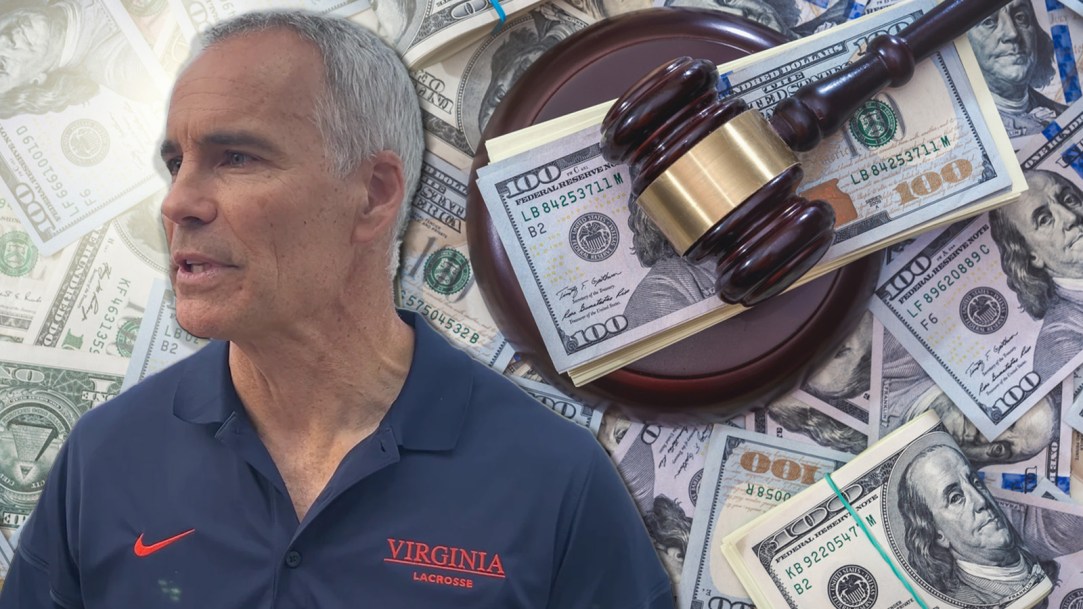
Lars Tiffany expected to be the college lacrosse coach at Virginia through 2029. And then he was suddenly “let go” in May.
The university claims he was not fired. The two-time national champion does not see it the same way.
A new legal filing from the legendary lacrosse coach seeks $1.4 million in unpaid wages. A court will now have to decided whether a signed contract extension was or was not valid after what the university claims was a counter offer.
Lars Tiffany will not return to coach college lacrosse at Virginia.
Lars Tiffany was hired as the head lacrosse coach at the University of Virginia in 2017. His decade-long tenure with the program was an overwhelming success. The Cavaliers won “back-to-back” national championships in 2019 and 2021 and reached the Final Four in 2023 and 2024. They made the postseason in seven of nine seasons.
However, Virginia finished below .500 in 2025 and lost in the first round of the NCAA Tournament in 2026 after a difficult start to the year that included an upset loss to Towson. It was a frustrating result for a team that expects to compete for a national title.
And then Tiffany was “let go” about two weeks later.
The administration in Charlottesville thanked the legendary coach for his contributions to the program and later hired top assistant Kevin Cassese as his successor. That was the end of it. Tiffany was out after 10 years.
Nobody saw it coming. Not even the head coach himself.
Tiffany had already met with the individual players on his roster to start planning for 2027. It was his understanding that he was employed through 2029. He thought he had signed a three-year contract extension in late March to stay with Virginia.
The Cavaliers say otherwise. They claim the extension was not valid. They chose not to renew his deal. He was not fired.
A new legal filing seeks compensation for the signed contract extension.
As first reported by Dan Arestia, Lars Tiffany is taking legal action against Virginia. He filed a declaratory judgement action against the university that seeks $1.4 million in financial compensation.
The university offered him a three-year contract extension in the summer of 2025. There was a little bit of back and forth chatter about a fourth year but it never came to fruition. Tiffany ultimately signed and returned the three-year extension to the university, using the same process used for his first extension. It was not any different from 2021.
Virginia does not agree. The Cavaliers contend that the initial discussion surrounding the addition of a fourth year to his contract was a counter offer. The counter offer made their initial three-year offer invalid so, even though Tiffany signed and returned the offer sheet, it does not need to be honored. They do not owe him any additional money.
The new legal filing takes the opposite position.
Tiffany alleges that Deputy Athletic Director Steve Pritzker reached out to Tiffany’s agent at the time of his signing to say that a mistake had been made and asked Tiffany to rescind the acceptance of his extension. Tiffany did not rescind his acceptance.
As a result, he expected to return as the head coach through 2029— or to be fired and to receive a pay out. That did not happen.
Tiffany’s lawsuit claims that his signed offer sheet was still valid because neither he nor his agent made a formal counter offer. Nor was the offer sheet rescinded. Nor did he rescind the acceptance of the offer. So if Virginia still wants to let him go, fine, but it owes him the compensation that was outlined in the signed offer sheet.
A formal statement:
My family and I are deeply saddened to be leaving the University of Virginia and the men’s lacrosse program that we love so dearly.
Working at UVA never felt like a job; it was a privilege and a gift. The relationships we have built with our student-athletes, alumni, supporters, and the Charlottesville community will remain among the most meaningful experiences of our lives.
Earlier this year, I signed a three-year contract extension with the University. Unfortunately, the University has now informed us that it does not intend to honor that agreement.
We made every effort to resolve this matter privately and amicably. Litigation was never our goal. Unfortunately, after being advised that the University was preparing to seek declaratory relief regarding the contract, my family and I were left with no meaningful alternative but to protect our rights through the legal process.
It is with a heavy heart that we find ourselves in this position. Going to court is the last thing we wanted. We had hoped to conclude this chapter with gratitude, respect, and mutual appreciation for everything we accomplished together.
However, I have an obligation to my family and to the commitments that were made. While we are disappointed that this dispute could not be resolved without litigation, we remain proud of what we built at Virginia and grateful for the players, families, alumni, and supporters who made this journey so special.