


© Dan Rainville / USA TODAY NETWORK via Imagn Images
The Pennsylvania Interscholastic Athletic Association knows it has a problem on its hands. But for the time being, it is passing the buck to someone else to fix that problem.
For the last several years, PIAA sports have been largely dominated by private schools, which compete alongside public schools for state championships while not having to adhere to the same rules regarding where they can pull players from.
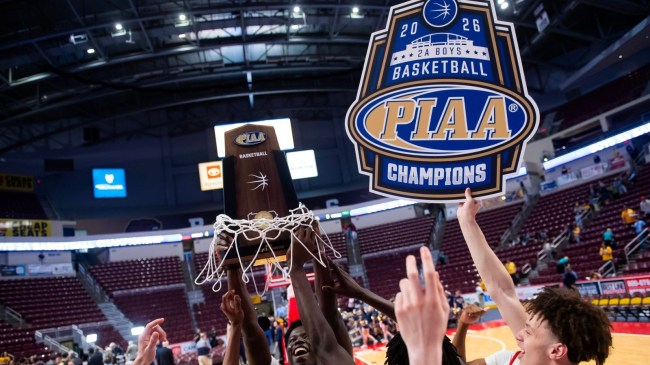
This significant difference was highlighted at the recent 2026 PIAA basketball championships, where private schools won five of six boys’ classifications and three of six on the girls’ side.
After his school’s loss to Sewickley Academy in the Class 2A boys’ championship game, Old Forge School District superintendent Chris Gatto wrote a letter to the PIAA addressing the inequities and calling for change.
“This is not about the outcome of one game,” Gatto wrote. “This is about a system the PIAA continues to defend that is fundamentally flawed.”
Gatto is far from the only one to speak up in recent years. But rather than addressing the issue, the PIAA is seemingly passing the buck.
PIAA President Blames State Law For Lack Of Public And Private School Separation
On Tuesday, PIAA executive director Mark Byers responded to Gatto’s letter, claiming that the association’s hands are tied regarding the matter.
“The primary obstacle to substantial reforms is the language of the existing legislation,” Byers wrote. “Absent such change, we will continue to regularly assess the situation and seek means to best ensure competitive equality within the scope of the law.”
Byers notes that the PIAA was founded in 1913 as a voluntary association of public schools. The PA legislature later passed Act 219, amending the Public School Code and admitting private schools for membership in the PIAA. In 1974, it expanded those requirements regarding Pittsburgh schools.
“As an Association of member schools, the Board is responsible for ensuring that any action is not violative of the statutory and equal protection rights of all members,” Byers wrote.
However, some have argued that the legislation only states that the PIAA cannot prohibit private from being members of PIAA, not that the PIAA cannot create separate classifications for those schools.
Gatto, meanwhile, is supporting another solution.
He has expressed support for House Bill 41, which would create separate postseason tournaments for all public and private schools.
“This is not about taking anything away from private schools,” he says. “It is about acknowledging reality and structuring competition accordingly.”
For now, it appears that if Gatto wants to get his wish, it will have to come from the state government, not the athletic association.