


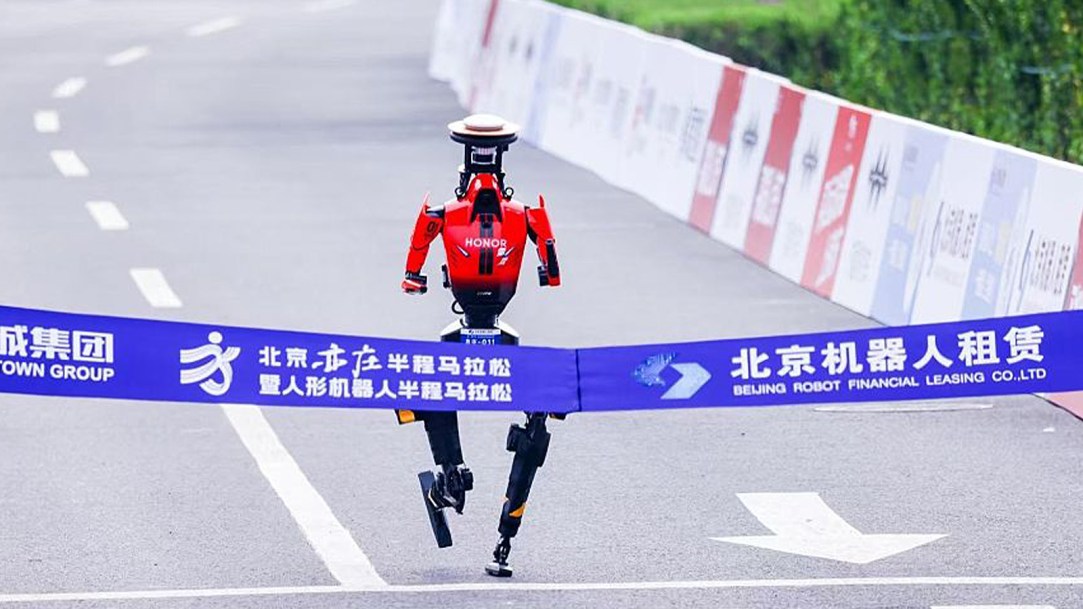
There has been a lot of talk about a fully autonomous robot that broke a human world record during a half marathon in China. That is mostly true.
It is not the full story of what happened.
There were certain parameters in place for the half-marathon that provide important context to the impressive (and frightening) technological feat. It is not quite what it sounds.
The Yizhuang half-marathon is held in Beijing.
This was the second year of this man vs. computer competition. 21 humanoid robots ran at the Yizhuang half-marathon in Beijing on April 19, 2025. The results were fairly disappointing (or encouraging, depending on how you look at the advancement of technology).
Most of the robots did not finish and the winning robot with a time of two hours and 40 minutes, which was more than double the time of the human winner. They were slow.
This year’s competition took place exactly 365 days later and went a lot better (or worse, depending on how you look at the advancement of technology).
First of all, there were a lot more robots in the field in 2026 compared to 2025. The number of participating teams increased from ~20 to more than 100.
Not only were there more robots, the finishing rate was much higher. Several of the top robot finishers also ran a faster time than the top human professionals. Some of them by more than 10 minutes.
And not only that, many of the robots beat the humans without human guidance. Nearly half of the entrants were considered “autonomous,” meaning that they act independently. An operator essentially hits “go” and the robot can navigate the course on its own. There is no remote control.
An autonomous robot set the world record, kind of.
All three of the top spots on the podium were claimed by various teams from Honor, a Chinese smartphone developer. The fastest robot finisher crossed the line in 48 minutes and 19 seconds.
However, the robot needed human assistance after it crashed to the ground just a few feet before it broke the tape. It was also tele-operated, which resulted in a 1.2X time penalty.
This Chinese humanoid robot just shattered the world record for a half marathon, finishing in 50 min 26 sec.
— Kyle Chan (@kyleichan) April 19, 2026
This video shows its crash just meters before the finish line where it had to be picked up by a team of humans. The robot is from Honor, the smartphone maker and Huawei… pic.twitter.com/HflDC0rInX
A nearly identical and fully autonomous robot, which was made by the same team at Honor, was crowned the official winner with a time of 50 minutes, 26 seconds. That time is nearly one full minute faster than Ugandan runner Jacob Kiplimo, who set the world record for humans in Lisbon last month at 57:20.
Honor's (荣耀) FULLY AUTONOMOUS (not remote) Robot No. 9 "Lightning" (闪电) won the race
— China Research Collective (@CRC_8341) April 19, 2026
Key Supply Chain Beneficiaries: Luxshare Precision iFlytek, etc.
Domestic component rate >90%
Uses MagicOS
More details about "Lightning" and SUPPLY CHAIN IMPACT:https://t.co/KNc9SzRRfX https://t.co/CBDRJmmTgM pic.twitter.com/ma40Sud46G
The robot was fitted with legs between 35 and 37 inches to mimic elite human runners. It utilized the same liquid cooling technology that is used in Honor’s smartphones.
You can watch the entire robot half-marathon race here:
But here’s the thing. As impressive as this world record performance might be, especially considering the year-over-year advancements in technology, there are some important caveats.
The winning robot featured onboard perception and onboard decisioning. But the race took place on a pre-mapped and pre-rehearsed route that is beaconed by GNSS satellites. Engineers followed the robots in chase vehicles and allowed to intervene at designated aid stations. Battery swaps were also permitted.
These parameters are important! This was not a situation where a random fully-autonomous robot was set loose on a race course it did not know and completed the race without human intervention. The technology is not quite there yet. Though, it seems like it soon will be.