


USA TODAY Network via Reuters Connect
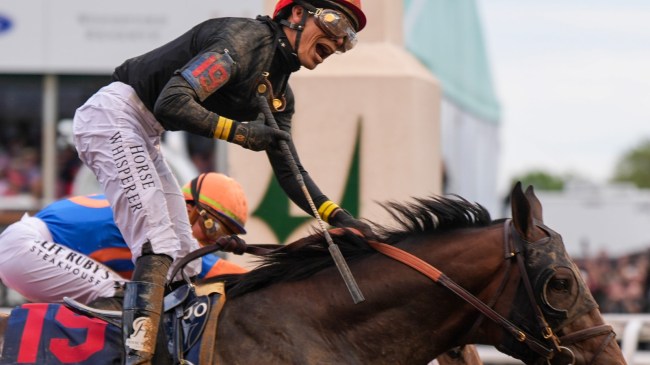
Golden Tempo won the Kentucky Derby as a 23-1 longshot. It will not compete at the Preakness Stakes in Baltimore.
Trainer Cherie DeVaux confirmed the refusal days after her win at Churchill Downs. It sparked an immediate debate with some questioning her motives.
This has become a trend of late. Three of the last five Kentucky Derby winners opted to skip the Preakness, effectively removing themselves from Triple Crown contention.
They’ve cited rest and horse health in their decision-making. Is that the real reason? If so, is there a way to fix the issue and prevent it from continuing?
Golden Tempo will skip the Preakness.
Preakness announcement pic.twitter.com/8JQu7VZlRC
— Cherie DeVaux (@reredevaux) May 6, 2026
The announcement comes one year after Sovereignty did the same. There have been 14 Kentucky Derby winners to bow out of the Preakness across the races’ 150+ year existence.
Four have come since 2021.
DeVaux provided an update on Golden Tempo’s status on social media. “We believe the best decision for him moving forward is to give him a little more time following such a tremendous effort,” her statement read.
“His health, happiness, and long-term future will always remain our top priority.”
That decision was applauded by many, who criticized Triple Crown scheduling.
Sigh… Please, Triple Crown people, create a schedule that encourages participation in all three races. This stubbornness about the dates of these races is self-defeating. Most major sporting events have allowed their schedules to change to accommodate changes in the sport. https://t.co/bMKbUEfNwH
— Chuck Todd (@chucktodd) May 6, 2026
It’s been an issue discussed in the past. Golden Tempo’s denial may very well be the tipping point to force a change.
The Preakness comes two weeks after the Kentucky Derby. It is quickly followed by the Belmont Stakes. Rather than put the horse through the grueling month-long stint, recent trainers have opted to bypass Baltimore and make their return in New York.
While the schedule has created concern, there are some that are opposed to an adjustment. It’s been this way for more than a century. Why change now?
The Preakness does not need to be moved.
Thanks for coming to my Ted Talk.
— Mary Elizabeth (@missmaryeliza) May 6, 2026
Many of the horses that don’t win the Kentucky Derby still join the field at the Preakness, though that number is on the decline, too. If others can do so, why won’t the winners?
Is there another motive behind the decision?
There may very well be in the case of Golden Tempo, whose running style is less effective at the Preakness. The horse is a come-from-behind assassin. Often it finds itself at the back of the pack before making a late push.
That was again the case at Churchill Downs. Golden Tempo was in last place for a large majority of the competition. It didn’t get going until the home stretch.
The Preakness is shorter than the Kentucky Derby. The ability to make a late run is minimized.
Derby winners average a race time of around 2 minutes and 3 seconds. The Preakness time comes in at 1:55. Those eight seconds can make a huge difference.
A poor showing in the event could impact future breeding value. The Belmont Stakes will represent a return to a longer track. If Golden Tempo places in New York after skipping the Preakness, the optics are much more positive.
Translation: We were a 23-1 long-shot to win the Derby and don’t think we would win the shorter track against a horse like Renegade again. So we will preserve our horse’s health — AHEM! “Value” — and get the max we can for future stud fees.
Gutless horse owners have killed this… https://t.co/ur7tYElsmK
— Mark Zinno (@MarkZinno) May 6, 2026
Regardless of the reasoning, Cherie DeVaux’s decision puts pressure on the Triple Crown races to adapt. Suggestions have been made to put a month in between events, with the Derby kicking off in May, the Preakness in early June, and the Belmont around 4th of July.
The burden now rests on those decision makers. If they do cave to the criticism, there will be no excuse for Kentucky Derby winners to pass on other Triple Crown legs.