



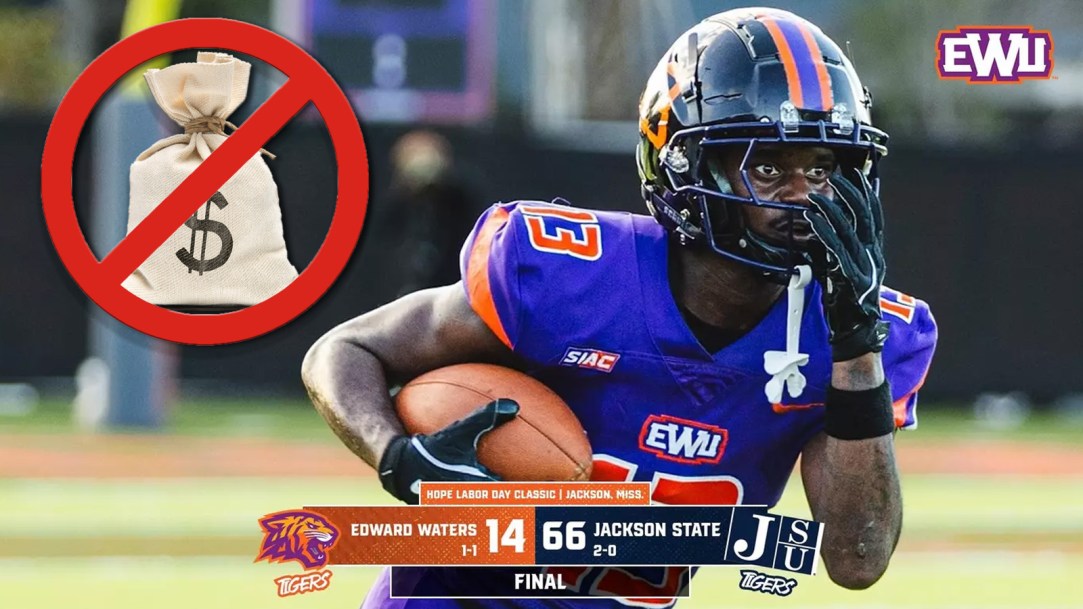
Edward Waters got paid approximately $985 for every point scored against them during the college football game against Jackson State over Labor Day Weekend. It was not enough money to do it again.
President A. Zachary Faison Jr. vows to never to play a “buy game” again unless the financial incentive is worth the result.
His candid approach to the college football schedule puts players and coaches first. That is admirable.
What is a “buy game” in college football?
If you are reading this article, you likely know the term already. A buy game is common place on every level of the sport. That includes FBS, FCS, Division II, Division III and even NAIA. They most commonly occur during the early season.
A “bigger” program pays a “smaller” program an agreed upon amount of money to travel for a game it will likely lose to fill out the schedule. For example, Alabama might pay Mercer to play in Tuscaloosa. Or Ohio State might pay Kent State to play in Columbus. Both of those schools expect to win those games against “inferior” opponents.
You get the idea. The big school pays the small school to (hopefully) lose.
Although it is not super common, a “buy game” can sometimes backfire. For example, Kansas State paid more than $1 million to lose to Army at home last season. Rutgers just paid ~$1.5 million to lose to UMass at home in the season-opener last Thursday.
This does not only apply to FBS teams. Jackson State, an FCS school, played Edward Waters, a Division II school, on Saturday.
The Tigers of Jackson State defeated the Tigers of Edward Waters by a final score of 66-14. The former paid the latter to lose.
Edward Waters did not make enough money from Jackson State.
Edward Waters University is a private HBCU in Jacksonville, Florida. It enrolls approximately 1,200 students. Jackson State University is a public HBCU in Jackson, Mississippi. It enrolls approximately 6,500 students.
Jackson State paid Edward Waters a guarantee of $65,000 for the game on Saturday. However, Edward Waters cleared only $30,000 after ~$35,000 in travel and related expenses. That is not a small amount but it still wasn’t enough.
President A. Zachary Faison Jr. released a statement of apology to the football program. He set up his players to lose and they did not earn enough money to make the loss worth the financial trade off.
“First, to the young men who took the field Saturday afternoon at Jackson State: I am proud of you. You fought. You did not quit. Down after down, in a setting built to overwhelm a visiting team, you kept competing. That resolve reflects what our coaches and athletics leadership have built here, and I saw it clearly […]”
“That said, and secondly, I owe you an apology, because the position we placed you in Saturday was not your doing and it was not your coaches’. That game went on our schedule two years ago and I enthusiastically supported it. The decision was mine, and I own it.”
President Faison will not make that same decision in the future. The potential for a blowout, 52-point loss has to be worth the money.
“Going forward, Edward Waters University will not schedule Division I opposition in football except on terms this institution sets and that materially and substantially advance our program goals.”
The $30,000 payout was not enough. He vows to never put his players or his coaches in that position again. The amount of money Edward Waters received from Jackson State does not compare to other “buy games” around the country.
“Florida A&M receives $740,000 at Miami;
Morgan State receives $600,000 at Arizona State;
Tennessee State received $600,000 at Georgia;
Arkansas Pine Bluff receives $550,000 at Missouri;
Howard receives roughly $1,000,000 across games at Indiana and Rutgers;Another HBCU program was paid $1,000,000 to play at Ohio State last season and lost 70 to 0. Taken together, HBCU football programs will take in close to $7,000,000 from these games in 2026.
Tennessee State is the clearest illustration. That is a very capable FCS program which lost to this same Jackson State team by two points the week before, and it was beaten 63 to 3 by my alma mater, the University of Georgia, on Saturday. The result says nothing about Tennessee State. It says everything about what happens when a program plays division(s) above itself. The difference is that Tennessee State went home with $600,000 and can convert it into something materially significant for its program. That is a defensible trade. Ours was not.”
— President A. Zachary Faison Jr.
You can read his full (two-part) post here:
Edward Waters will not even consider another FBS matchup in the future unless it expects to clear at least $100,000 after expenses. President Faison instead plans to prioritize other Division II opponents that can support the program’s postseason goals. He showed an amount of candidness and accountability that I have never seen from a university president in regard to athletics. His approach should be admired.