



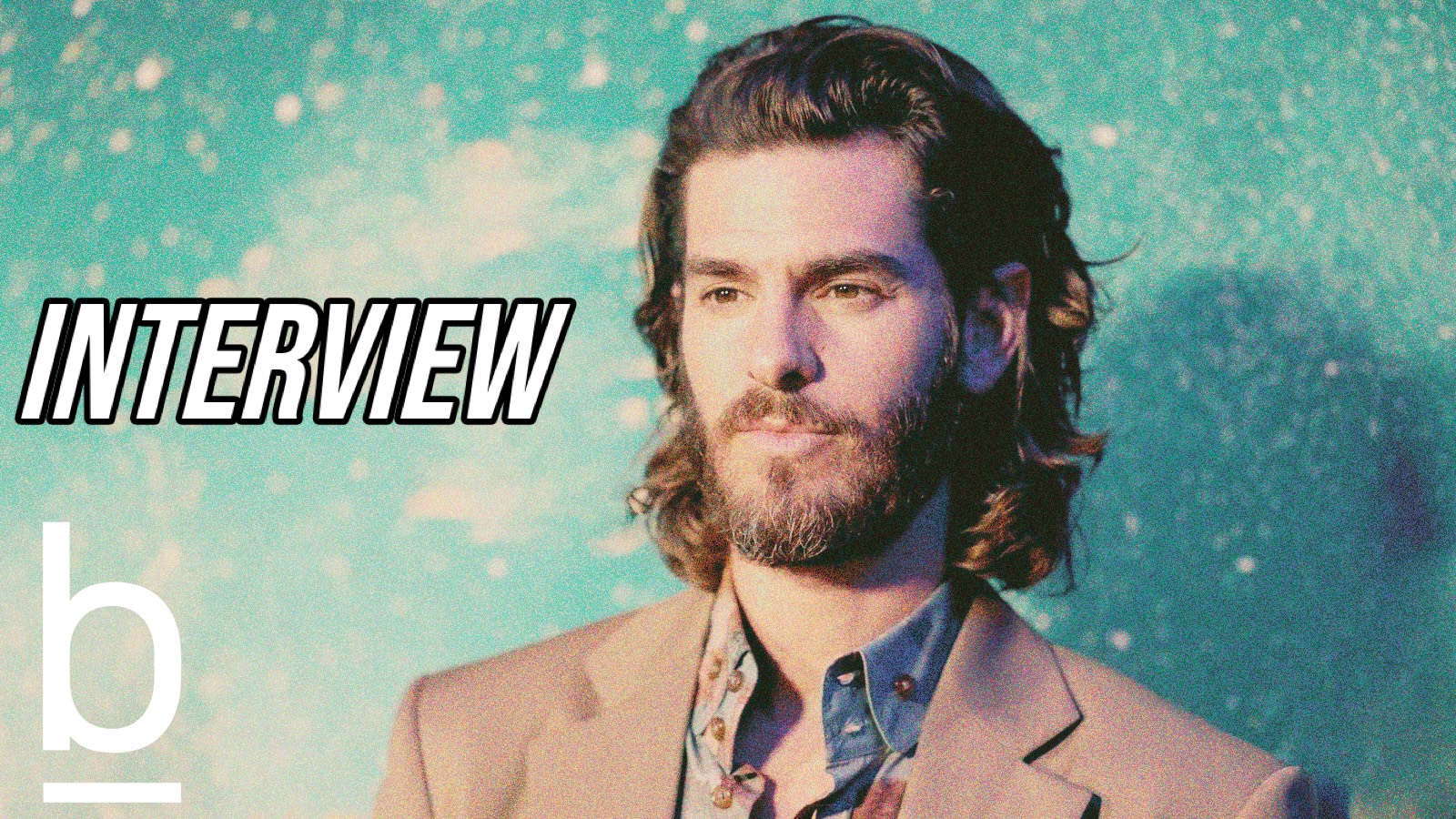
Cindy Ord/WireImage
My beloved mother, Ellen, passed away last year at the age of 64, just a couple of months after my wedding. While not normally the sort of topic I’d bring up in a junket interview, the universe conspired to make sure I’d have no choice.
On her first birthday since her passing — Monday, August 31 — I had an interview scheduled. Despite being on vacation with my family down the Jersey Shore to celebrate my Mom’s life, I kept the interview on the books anyway. The chance to interview two-time Oscar nominee Andrew Garfield doesn’t come around often, after all. And even less so on such a significant day in your life.
Over the last few years, Garfield has gone viral numerous times for his heartfelt and honest expressions of grief, detailing how he’s dealt with the death of his mother to the likes of Stephen Colbert, Anderson Cooper, and even Elmo.
Given the chance to speak to Garfield ahead of the release of his new film The Uprising — the latest project from acclaimed Bourne franchise and Captain Phillips director Paul Greengrass, hitting theaters on September 10 — I used the opportunity to thank Garfield for being such a positive example of constructively confronting grief, rolling around in the mud with Greengrass, his memories of working with Martin Scorsese on Silence, what makes Spider-Man so popular, and more.
“It was a privilege to be muddy with Paul Greengrass” on the set of The Uprising, Garfield says
ERIC ITALIANO, BROBIBLE: I want to talk about dirt. You spend this entire film wet, dirty, muddy, sweating, and so on — and you actually have some experience with this in the past, on Silence and Hacksaw Ridge. Beyond the obvious aesthetics, how does making a film in which you’re constantly in some state of filth differ from the rest? How does it impact your performance, both internally for yourself and externally for us?
ANDREW GARFIELD: Yeah, it’s a specific relationship to the earth. To the loamy earth. And that’s the character — he’s a man of the earth, a man of the soil. So that relationship is primary, and it’s primary throughout the film.
It was a delight to be able to roll around in the mud and create a different relationship than a modern person would have with it. It’s very primal. There’s a lot of energy there. It feels like people are getting into gardening again, growing their own food and plants — there’s a connection to the soil that people in the modern world are finding themselves drawn to more and more. So yeah, it was a privilege. Let’s put it that way. It was a privilege to be muddy with Paul Greengrass.
EI: So it doesn’t make the job harder for you?
AG: [laughs] Yes, of course it does.
EI: You’re just going to lead with the good stuff.
AG: There’s a transition you have to step over — a threshold. But I have to tell you, I had a couple of weeks ahead of time hanging out on set, in the Ploughman’s hut and his field, and I was introduced to the ox, Prince, who was going to be my ox. And honestly, some of my favourite memories of the film were just leaning on Prince, feeling the warmth of his huge f—— body, the weight of his breath, and the kinship — the friend I found in him. He was kind of agnostic towards me, and there was a beauty to that.
I would feed him; I’d tell him to move here and there. But there was a sweet brotherhood that I felt develop.
EI: That is a truly genius way to connect to the type of person and the time period you’re playing, because that relationship between man and animal has not changed. Of the few things you could experience that are exactly the same as them, that’s one of them.
The experience of filming Artificial and The Uprising, two films at opposite ends of the socioeconomic spectrum, back-to-back
Andrew Garfield on playing OpenAI CEO Sam Altman in Luca Guadagnino’s ARTIFICIAL:
“A modern emperor… who genuinely feels like he is the right leader for this moment.”
Full interview 📲 https://t.co/E2Quk5pDYC pic.twitter.com/8RHk09YSNC
— Eric Italiano (@ericitaIiano) September 2, 2026
EI: Between THE UPRISING and your next film, ARTIFICIAL, you’re playing on two polar opposite ends of the socioeconomic spectrum. In fact, it could be argued that Sam Altman and his fellow tech overlords see themselves as our new kings. How did playing two characters on such polar opposite sides — particularly when it comes to the issues of wealth and power — what was that like for you? And did it change your own personal opinions or perspective at all?
AG: Yeah, I appreciate the question. The first project I shot was the ARTIFICIAL film, and then I went and shot THE UPRISING straight after. I’m really, really happy it was in that order, because it felt like playing Ploughman was a direct kind of healing response to —
EI: Wash that filth off of you with some dirt?
AG: Your words, not mine! But it was interesting. You could say you play an emperor, a modern emperor, and then you play someone who’s at the mercy of the rules and the decisions the emperors are making.
It was the right order. It was fascinating. Absolutely fascinating, and I’m very, very grateful for the experience. And you’re right — they couldn’t be more opposite. They are the polar opposites of our culture right now. I feel very lucky to have felt the disparity of those experiences.
Playing different types of “heroes” in The Uprising, The Amazing Spider-Man, and Artificial
EI: And then you have a fascinating professional relationship with playing a hero. You could play a hero that everybody knows like the back of their hand, in Spider-Man. You’re playing a sort of vaguer hero that nobody’s ever heard of in Ploughman. And then you’re playing somebody like Sam Altman, who thinks they’re the hero of their own story but is more likely the villain — again, my words, my words!
How are those different shades of hero? How does that work for you in terms of bringing those to life?
AG: Yeah, it’s a cool question. I hadn’t really thought about that before.
Peter Parker is obviously a reluctant hero, but very well known, very famous in that way. And then Ploughman — again, a very reluctant hero. There’s no doubt he would never identify himself in any way as heroic. He’s just doing what his soul requires. He’s being led by his soul.
And then there’s Sam, who I do believe feels like he is the right leader for this moment. I feel like that’s a genuine self-belief. And you hope there’s healthy questioning in there.
The Ploughman is someone who has the humility accessible to him, so he feels like he shouldn’t lead — which makes him a great leader. And then you have Sam, who has chosen the position. Or maybe he actually perceives it as having been thrust upon him as well; I don’t know.
But it’s very interesting to consider the responsibility — to go back to Peter Parker — of the power that is either thrust upon us or that we choose to adopt.
The enduring universal appeal of Spider-Man and what it means to play such a beloved character
EI: You bring up Peter. I don’t know if you heard, but there’s a new SPIDER-MAN film out, and it’s making insane amounts of cash. The character seems to be more popular than ever. As of speaking, it is the fourth highest-grossing film of all time and is now the second highest-grossing movie franchise of all time, behind only the MCU and ahead of Star Wars, Harry Potter, James Bond, and so on.
If you had to boil it down to one thing — what do you think it is about this character that makes him so enduring and so universal? And what does it mean to you that you had the chance to bring a character that means so much to so many people to life?
AG: It’s a humbling thing, for sure. It’s a strange thing to be part of the legacy of a character who is one of the most beloved characters in the history of fiction. Universally, as you say.
And it’s mysterious. There are a lot of reasons you could point to, but I wouldn’t be able to tell you exactly why. I don’t have the ultimate conclusion about why Spider-Man is this beloved figure. But I think there’s something about the everyman-ness of him. The humility. The hapless ordinariness of Peter Parker, combined with the extraordinariness that we all have — we all have some great gift to give the world. It’s an archetypal hero’s story that we can all somehow feel connected to.
And also, under the suit, it could be anybody. You don’t see skin colour, you don’t see gender, you don’t see race, you don’t see socioeconomic background. It does help, I think, that he’s a working-class kid. He feels eternally relatable.
I haven’t seen the film yet. I’m very, very excited to see it, and Tom is obviously such a great actor for that character.
EI: If they ever do a LOGAN version of Spider-Man, you’ve got the Old Man Peter look down right now.
Memories of and feelings about working with Martin Scorsese on Silence
EI: I want you to walk with me for a bit. You’re lying up late at night. You’re in bed, maybe you can’t sleep. And you suddenly remember that you starred in a Martin Scorsese historical epic. What are the first memories and biggest emotions that come to you in that moment?
AG: Oh, yeah. I mean, it was a really cool time. I’m so privileged that I got to be with Marty on that project — to know him, to work with him, to work on that project and all the themes of it. And those Japanese actors are some of the most stunning performers and artists I’ve ever worked with. So I feel profound gratitude.
And then the memories are of Marty with his hiking stick, walking up in these impossible locations. An older man, just full of life and vigor, walking over these craggy landscapes to get shots of epic and barren and forbidding nature. He was very alive. Very lively while we were shooting. He’s just a very alive, vital man. So I feel very lucky.
How the passing of his mother has changed his process and his art; and what’d she think of his public expressions of grief
Spoke with Andrew Garfield about how his openness regarding the death of his own mother helped me process mine, and how such a life-altering event affects a profession and livelihood so intrinsically tied to emotion and experience.
Full interview 📲 https://t.co/Ih0zp1rYpZ https://t.co/d1OgkdF4r2 pic.twitter.com/b3teBSgo25
— Eric Italiano (@ericitaIiano) September 1, 2026
EI: So — the universe works in very strange ways. I’m talking to you today, and today is my mom’s first birthday since she passed last year. [shows photo] Here we are last summer, at my wedding, doing the PULP FICTION dance.
You’ve spoken so openly about your journey with grief following the death of your mom that it’s served as something of a North Star for me during this process. So I just, genuinely, man to man, want to thank you for that.
AG: Oh, dude. I hear you, and I’m really, really happy — thanks for showing me that photo. And the fact that she was able to be at your wedding day is a gift.
EI: She was my biggest fan. She was my best friend. You’ve spoken extensively about how you’ve dealt with it personally, but I’m curious how it’s dealt with you. How has it affected you professionally? I find the passing of my mom to be the most before-and-after moment of my life — I’m a different person. And given the engine of your work comes from emotion and experience, I’m curious how the passing of your mom changed you, and if that change has bled into your process and your work at all. Especially considering Ploughman’s past — I mean, it’s right there in the text.
AG: Yeah. No, definitely. And I appreciate you sharing that with me. I’m very touched by it. And I’m sure she’d be very, very proud of you and the man you are. I’m sure she always was.
It’s definitely a before and after. It’s like the world gets rearranged — or you just get revealed what the world was all along, and you were under some different illusion before.
On the most basic level, I suppose it’s awakened my consciousness to the temporariness of everything. That everything dies. That we’re all heading to the same place. And of course, if we work with that, if we acknowledge it and integrate it, it can make everything much more meaningful. It’s the only thing that makes everything sacred and meaningful in this life.
So I think, hopefully, it sharpens the aim of the arrow. In a way that could be a softening. Less knowing. More awakenedness to small things. More surrender to life on life’s terms. I hope for that — I hope that’s the way it has affected me, and continues to affect me. Less feeling like I need to have things figured out. More feeling that I want to just know life on all of its levels.
EI: Speaking of moms being proud — I did have written down here: what do you think it would mean to your mom that you’ve become something of the face of positively, constructively confronting grief, particularly as it relates to the death of a mom?
AG: Oh gosh. It was surprising to me that I was able to have conversations like I’ve had in public around that subject. It wasn’t part of a plan. It was something that just happened instinctively, in certain moments — and I’m really glad it did.
Because for whatever reason, it feels good to me to be able to destigmatise a conversation like this. Especially between two men. I think that’s very, very rare.
And I try to talk to my mother as often as I possibly can. I try to check in with her spirit.
The problem with my mother is that she would be proud of me if I was an axe murderer.
EI: I know what you’re talking about. That’s moms, though, right?
AG: Not all moms. Some moms — if you’re lucky. She would be delivering me home-baked cookies in jail until I perished there. So no matter what I do, she’s pretty happy that I exist, I think.
EI: Like I said — whenever I’m having difficulty, I find myself burying my feelings, suppressing the memories, just to be numb to it. And whenever I find myself doing that, I reflect on your words, and it’s a huge help to me. So thank you very much for that, and for your time today. I find that actors and celebrities can be controversial and divisive figures. You seem to be one of the most well-liked people in this business, and I think that’s because of the way you wear your heart and your soul on your sleeve, man. Thank you very much.
AG: Thank you, man. It’s nice to talk to you. And love to you. And — stay with the wound. Stay with the pain. It’s the place where all the gifts live.